

 Регистрирайте се като учител
Unknown Story


Текст на Статията
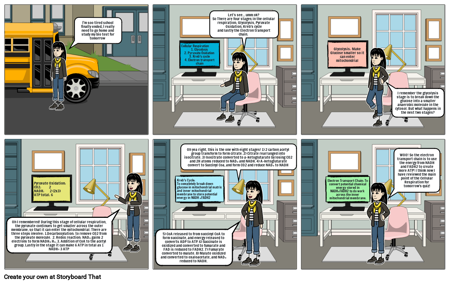
- I'm soo tired school finally ended, I really need to go home and study my bio test for tomorrow
- Cellular Respiration1. Glycolysis2. Pyruvate Oxidation 3. Kreb's cycle4. Electron transport chain
- Let's see... umm ok? So There are four stages in the cellular respiration: Glycolysis, Pyruvate Oxidation, Kreb's cycleand lastly the Electron transport chain.
- Glycolysis: Make Glucose smaller so it can enter mitochondrial
- I remember the glycolysis stage is to break down the glucose into a smaller anaerobic molecule in the cytosol. But what happens in the nest two stages?
- Oh I remembered! During this stage of cellular respiration, the pyruvate continues to get smaller across the outer membrane, so that it can enter the mitochondrial. There are three steps involve: 1.Decarboxylation: to remove CO2 from the pyruvate molecule. 2. Redox reaction: NAD+ gains 2 electrons to form NADH+ H+. 3. Addition of CoA to the acetyl group. Lastly in the stage it can make 6 ATP in total as 1 NADH= 3 ATP
- Pyruvate Oxidation:CO2: 2NADH: 2 (2x3)ATP total: 6
- 5) CoA released to from succinyl CoA to form succinate, and energy released to converts ADP to ATP. 6) Succinate is oxidized and converted to fumarate and FAD is reduced to FADH2. 7) Fumarate converted to malate. 8) Malate oxidized and converted to oxaloacetate, and NAD+ reduced to NADH.
- Kreb's Cycle:To completely break down glucose in mitochondrial matrix and inner mitochondrial membrane to store potential energy in NADH +FADH2
- Oh yea right, this is the one with eight stages! 1) 2 carbon acetyl group transform to form citrate. 2) Citrate rearranged into isocitrate. 3) Isocitrate converted to a-ketoglutarate by losing CO2 and 2H atoms reduced to NAD+ and NADH. 4) A-ketoglutarate convert to Succinyl Coa, and form CO2 and reduce NAD+ to NADH
- Electron Transport Chain: To convert potential chemical energy stored in NADH+FADH2 to do work across the inner mitochondrial membrane.
- WOO! So the electron transport chain is to use the energy from NADH and FADH2 to create more ATP! I think now I have reviewed the main point of the Cellular Respiration for tomorrow’s quiz!
Създадени са над 40 милиона сценария
Без Изтегляния, без Кредитна Карта и без Регистрация, за да Опитате!
