

Science-ICT_PT


Текст на Статията
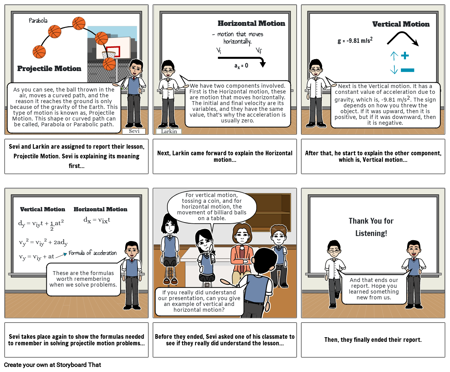
- As you can see, the ball thrown in the air, moves a curved path, and the reason it reaches the ground is only because of the gravity of the Earth. This type of motion is known as, Projectile Motion. This shape or curved path can be called, Parabola or Parabolic path.
- Projectile Motion
- Parabola
- Sevi
- Larkin
- We have two components involved. First is the Horizontal motion, these are motion that moves horizontally. The initial and final velocity are its variables, and they have the same value, that's why the acceleration is usually zero.
- - motion that moves horizontally.
- Vi             Vf
- Horizontal Motion
- ax = 0
- Next is the Vertical motion. It has a constant value of acceleration due to gravity, which is, -9.81 m/s2. The sign depends on how you threw the object. If it was upward, then it is positive, but if it was downward, then it is negative.
- g = -9.81 m/s2
- Vertical Motion
- Sevi and Larkin are assigned to report their lesson, Projectile Motion. Sevi is explaining its meaning first...
- Vertical Motion
- vy = viy + at
- dy = viyt + 1 at2
- vy2 = viy2 + 2ady
- These are the formulas worth remembering when we solve problems.
- 2
- Formula of acceleration
- Horizontal Motion
- dx = vixt
- Next, Larkin came forward to explain the Horizontal motion...
- For vertical motion, tossing a coin, and for horizontal motion, the movement of billiard balls on a table.
- After that, he start to explain the other component, which is, Vertical motion...
- Thank You for Listening!
- Sevi takes place again to show the formulas needed to remember in solving projectile motion problems...
- Before they ended, Sevi asked one of his classmate to see if they really did understand the lesson...
- If you really did understand our presentation, can you give an example of vertical and horizontal motion?
- Then, they finally ended their report.
- And that ends our report. Hope you learned something new from us.