

 Zaregistrujte se jako učitel
Untitled Storyboard


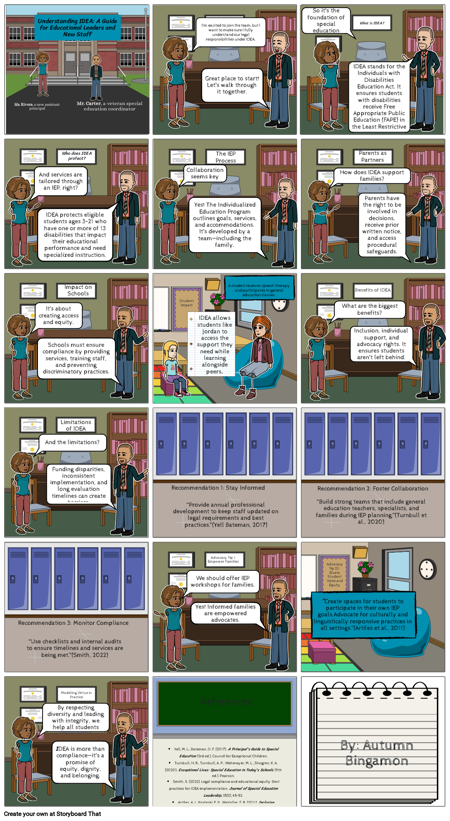
Storyboard Text
- Skluzavka: 1
- Understanding IDEA: A Guide for Educational Leaders and New Staff
- Mr. Carter, a veteran special education coordinator
- Ms. Rivera, a new assistant principal
- Skluzavka: 2
- I'm excited to join the team, but I want to make sure I fully understand our legal responsibilities under IDEA.
- Great place to start! Let’s walk through it together.
- Skluzavka: 3
- So it's the foundation of special education services?
- What is IDEA?
- IDEA stands for the Individuals with Disabilities Education Act. It ensures students with disabilities receive Free Appropriate Public Education (FAPE) in the Least Restrictive Environment
- Skluzavka: 4
- Who does IDEA protect?
- And services are tailored through an IEP, right?
- IDEA protects eligible students ages 3–21 who have one or more of 13 disabilities that impact their educational performance and need specialized instruction.
- Skluzavka: 5
- The IEP Process
- Collaboration seems key
- Yes! The Individualized Education Program outlines goals, services, and accommodations. It’s developed by a team—including the family.
- Skluzavka: 6
- Parents as Partners
- How does IDEA support families?
- Parents have the right to be involved in decisions, receive prior written notice, and access procedural safeguards.
- Skluzavka: 7
- Impact on Schools
- It’s about creating access and equity.
- Schools must ensure compliance by providing services, training staff, and preventing discriminatory practices.
- Skluzavka: 8
- A student receives speech therapy and participates in general education classes.
- Student Impact
- IDEA allows students like Jordan to access the support they need while learning alongside peers.
- Skluzavka: 9
- Benefits of IDEA
- What are the biggest benefits?
- Inclusion, individual support, and advocacy rights. It ensures students aren’t left behind.
- Skluzavka: 10
- Limitations of IDEA
- And the limitations?
- Funding disparities, inconsistent implementation, and long evaluation timelines can create barriers.
- Skluzavka: 11
- Recommendation 1: Stay Informed
- “Provide annual professional development to keep staff updated on legal requirements and best practices.”(Yell Bateman, 2017)
- Skluzavka: 12
- Recommendation 2: Foster Collaboration
- “Build strong teams that include general education teachers, specialists, and families during IEP planning.”(Turnbull et al., 2020)
- Skluzavka: 13
- Recommendation 3: Monitor Compliance
- “Use checklists and internal audits to ensure timelines and services are being met.”(Smith, 2022)
- Skluzavka: 14
- Advocacy Tip 1: Empower Families
- We should offer IEP workshops for families.
- Yes! Informed families are empowered advocates.
- Skluzavka: 15
- Advocacy Tip 23 : Elvate Student Voice and Equity
- “Create spaces for students to participate in their own IEP goals.Advocate for culturally and linguistically responsive practices in all settings.”(Artiles et al., 2011)
- Skluzavka: 16
- Modeling Virtue in Practice
- By respecting diversity and leading with integrity, we help all students thrive.
- IDEA is more than compliance—it’s a promise of equity, dignity, and belonging.
- Skluzavka: 17
- References
- Yell, M. L., Bateman, D. F. (2017). A Principal's Guide to Special Education (3rd ed.). Council for Exceptional Children.Turnbull, H. R., Turnbull, A. P., Wehmeyer, M. L., Shogren, K. A. (2020). Exceptional Lives: Special Education in Today's Schools (9th ed.). Pearson.Smith, S. (2022). Legal compliance and educational equity: Best practices for IDEA implementation. Journal of Special Education Leadership, 35(2), 45–53.Artiles, A. J., Kozleski, E. B., Waitoller, F. R. (2011). Inclusive Education: Examining Equity on Five Continents. Harvard Education Press.
- Skluzavka: 18
- By: Autumn Bingamon
Vytvořeno přes 40 milionů storyboardů
K Vyzkoušení Není Potřeba Žádné Stahování, Žádná Kreditní Karta a Žádné Přihlášení!
