

 Zaregistrujte se jako učitel
Unknown Story


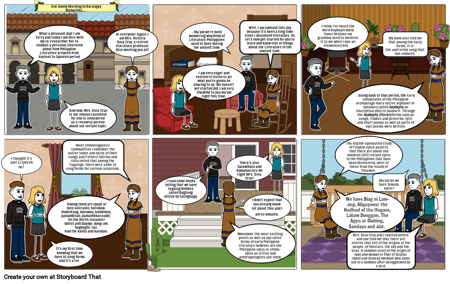
Storyboard Text
- What a pleasant day! I am Terry and today I am here with my co-researcher Rei to conduct a personal interview about How Philippine Literature aroused from Ancient to Spanish period
- One Sunny Morning In Barangay Maharlika.....
- And now, Mrs. Dela Cruz is our chosen raconteur for she is considered as a resource person about our certain topic.
- Hi everyone! Again, I am Mrs. Victoria Dela Cruz, a retired literature professor. Nice meeting you all!
- : Ma’am we’re both wondering whatkind of Literature Philippines used to have during the ancient time.
- I am very eager and excited to listen to all what you’re gonna be sharing to us. We haven’t yet started but I am very thankful to you ma’am right this time.
- Well, I am jubilant this day because it’s been a long time since I discussed literature. So, let’s now get started for you to learn and know lots of things about our Literature in the ancient time.
- I think I’ve heard the word Baybayin many times because my grandma used to mention it to me when I was an elementary kid.     
- : Going back to that period, the early inhabitants of the Philippine archipelago had a native alphabet or syllabary called baybayin, an inscription akin to Sanskrit. Through the baybayin, literary forms such as songs, riddles and proverbs, lyric and short poems as well as parts of epic poems were written.
- My mom also told me that among the early forms, it is the awit orthe song that has endured.
- I thought it’s just 11 only oh no!
- It’s my first time knowing that we have 16 song forms and it’s a lot.
-  Among them are uyaye or hele,soliranin, talindaw, kumintang, maluway, kundiman, panambitan, pamanhikan,subli, (In the North-Ilocanos) dallot and duayya, dung-aw, bagbagto, laji,And the kanta and kaludan.
- Most ethnolinguistic communities remember the native tunes and lyrics of their songs and Fathers Chirino and Colin noted that among the Tagalogs, there were some 16 song forms for various occasions.
- I read some books telling that we have tagalog Riddles called Bugtong utilize by talinghaga.
- Moreover, the most exciting poetic as well as narrative forms of early Philippine literature however are the Philippine epics or ethno-epics as critics and anthropologists call them.
- There’s also Salawikain and Ambahan.Are we right Mrs. Dela Cruz?
- I didn’t expect that you already know lot about this and I am so amazed.
- We have Biag ni Lam-ang, Aliguyonor the Hudhud of the Ifugaos, Labaw Donggon, The Agyu or Olahing, Sandayo and alot.
- The ASEAN-sponsored study of Filipino epics asserts that there are about one hundred (100) extant epics in the Philippines that have been discovered, most of these from the island of Palawan. 
- Mrs. Dela Cruz and I chatted before and she told me that there are stories that tell of the origins of the people, of thestars, the sky and the seas. A common story of the origin of man and woman is that of Sicalac (man) and Sicavay (woman) who came out of a bamboo after beingpecked by a bird. 
- Ma’am do we have famous epics?
Vytvořeno přes 40 milionů storyboardů
K Vyzkoušení Není Potřeba Žádné Stahování, Žádná Kreditní Karta a Žádné Přihlášení!
