

 Zaregistrujte se jako učitel
Pathogen Project


Storyboard Text
- Skluzavka: 1
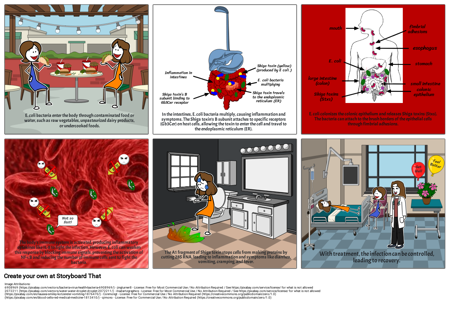
- E. coli bacteria enter the body through contaminated food or water, such as raw vegetables, unpasteurized dairy products, or undercooked foods.
- Skluzavka: 2
- Shiga toxin (yellow) (produced by E coli.)
- Inflammation in intestines
- E. coli bacteria multiplying
- Shiga toxin travels to the endoplasmic reticulum (ER)
- Shiga toxin’s B subunit binding to Gb3Cer receptor
- In the intestines, E. coli bacteria multiply, causing inflammation and symptoms. The Shiga toxin’s B subunit attaches to specific receptors (Gb3Cer) on host cells, allowing the toxin to enter the cell and travel to the endoplasmic reticulum (ER).
- Skluzavka: 3
- fimbrial adhesions
- mouth
- esophagus
- E. coli
- stomach
- large intestine (colon)
- small intestine
- colonic epithelium
- Shiga toxins (Stxs)
- E. coli colonizes the colonic epithelium and releases Shiga toxins (Stxs). The bacteria can attach to the brush borders of the epithelial cells through fimbrial adhesions.
- Skluzavka: 4
- IL-8
- IL-8
- IL-8
- IL-8
- Not so fast!
- The body's immune system is activated, producing inflammatory cytokines like IL-8 to fight the infection. However, E. coli can weaken this response by blocking immune signals, preventing the activation of NF-κB and reducing the number of immune cells sent to fight the bacteria.
- Skluzavka: 5
- The A1 fragment of Shiga toxin stops cells from making proteins by cutting 28S RNA, leading to inflammation and symptoms like diarrhea, vomiting, cramping, and fever.
- Skluzavka: 6
- Feel Better
- Get Well
- With treatment, the infection can be controlled, leading to recovery.
Přidělení Obrazu
- https://pixabay.com/en/nausea-smiley-kotzender-vomiting-1876470/ - Conmongt - (Licence Free for Commercial Use / No Attribution Required (https://creativecommons.org/publicdomain/zero/1.0) )
- https://pixabay.com/en/blood-cells-red-medical-medicine-1813410/ - qimono - (Licence Free for Commercial Use / No Attribution Required (https://creativecommons.org/publicdomain/zero/1.0) )
- 2072211 - madartzgraphics - (Licence Free for Most Commercial Use / No Attribution Required / See https://pixabay.com/service/license/ for what is not allowed )
- 6908969 - jingturner8 - (Licence Free for Most Commercial Use / No Attribution Required / See https://pixabay.com/service/license/ for what is not allowed )
Vytvořeno přes 40 milionů storyboardů
K Vyzkoušení Není Potřeba Žádné Stahování, Žádná Kreditní Karta a Žádné Přihlášení!
