

Financial Literacy Part 2


Storyboard Text
- Skluzavka: 1
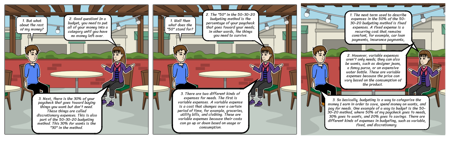
- 2. Good question! In a budget, you need to put all of your money into a category until you have no money left over.
- 1. But what about the rest of my money?
- 3. Next, there is the 30% of your paycheck that goes toward buying things you want but don't need. These things are called discretionary expenses. This is also part of the 50-30-20 budgeting method. This 30% for wants is the "30" in the method.
- Skluzavka: 2
- 2. The "50" in the 50-30-20 budgeting method is the percentage of your paycheck that goes toward your needs; in other words, the things you need to survive.
- 1. Well then what does the "50" stand for?
- 3. There are two different kinds of expenses for needs. The first is variable expenses. A variable expense is a cost that changes over a certain period of time, for example, groceries, utility bills, and clothing. These are variable expenses because their costs can go up or down based on usage or consumption.
- Skluzavka: 3
- 1. The next term used to describe expenses in the 50% of the 50-30-20 budgeting method is fixed expenses. A fixed expense is a recurring cost that remains constant, for example, car loan payments, insurance payments, etc.
- 2. However, variable expenses aren't only needs; they can also be wants, such as designer jeans, a fancy purse, or an expensive water bottle. These are variable expenses because the price can vary based on the consumption of the product.
- 3. So basically, budgeting is a way to categorize the money I earn in order to save, spend money on wants, and pay for needs. One example of a way to budget is the 50-30-20 method, where 50% of my paycheck goes to needs, 30% goes to wants, and 20% goes to savings. There are different kinds of expenses in budgeting, such as variable, fixed, and discretionary.