

Untitled Storyboard


Storyboard Text
- Skluzavka: 1
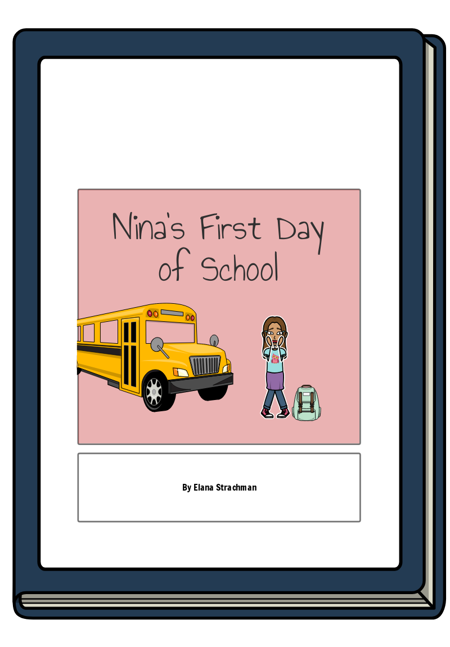
- Nina's First Day of School
- By Elana Strachman
- Skluzavka: 2
- Today is Nina's first day of Kindergarten! She is so excited to finally begin!
- Skluzavka: 3
- Nina’s mom drops her off and goes to say goodbye. Suddenly she realizes that she’s going to be all alone and can’t help but cry.
- Skluzavka: 4
- Two kisses and a hug every morning!
- Her mom gives her a big hug and tells her that everyday at drop off they can have a special routine. Nina chooses to do two kisses and a hug. This helps calm her down and give her familiarity.
- Skluzavka: 5
- After Nina’s mom leaves, her teacher brings her into the classroom. She shows all the kids the huge piles of toys and blocks in the corner.
- Skluzavka: 6
- Nina is so excited to build a tower with the cool blocks. Just as she's putting the final block on, another boy comes and knocks it over.
- Skluzavka: 7
- I was using those blocks, maybe we can share and build together instead?
- Sure!
- As she can begin to feel the tears starting in her eyes, Nina remembers what her mom told her about using her words.
- Skluzavka: 8
- Nina
- After finishing up with the toys, Nina is getting hungry. She notices everyone else already has someone to sit with in the cafeteria. She can feel her face begin to get hot as she looks around.
- Skluzavka: 9
- Deep breaths Nina
- Nina
- Nina’s teacher notices her and grabs her hand. She reminds Nina to take big deep breaths to calm her body down. Nina notices the boy she played with is also sitting alone and goes to join him.
- Skluzavka: 10
- But I'm not ready yet!
- Ok class, time to come inside!
- After lunch, the class get to go outside and play on the playground. Nina is having so much fun, she refuses to get off the swings when the bell is rung.
- Skluzavka: 11
- What's wrong, Nina? What are you feeling?
- I want to play more.
- Nina’s teacher comes over and asks her what’s bothering her. Nina says she is feeling upset since she’s having so much fun playing. Her teacher reminds her that they will be back tomorrow with more time to play.
- Skluzavka: 12
- I had so much fun!!
- At the end of the day, Nina’s mom comes to pick her up. She’s so excited to tell her about all the fun she had, and can’t wait to come back tomorrow.
- Skluzavka: 13
- Author's Note
- Adjusting and accepting change can be very difficult for all ages, but especially young children. Starting school can be not only a scary experience being away from comfort and family, but also a very overwhelming one. Being thrown into a new situation where you don't know anyone, and are following an unfamiliar experience can be difficult to handle. Kindergarten is often the first time that many children really make this change. With each hardship overcome, the child will learn more about their body and how they may react to situations.The goal and purpose of this book is to provide families with ways to ease their way into this transition. By creating a story, these emotional self regulation techniques can be more fun and interactive. Eventually, they will become second nature to the child. Through the process of creating this story, I realized how many different ways there are to regulate the body. Each of the provided techniques can be adapted and personalized to each individual and their situations. With time, transitions will become easier and less worrisome.
- Skluzavka: 14
- Target Age Range: Age 4-6
- Parent/Teacher Guide
-
- -Remember to remind the child to take a moment and take a breath before reacting-Talking through the big feelings can be very valuable-Some transitions take time to adjust to, don't rush it if you don't need to-These tactics can be used in situations outside of a school setting as well
- Reflection Questions1. What looked like the most fun part of Nina's day?2. What would your special goodbye routine be?3. What are you most excited for about starting school?
- Skluzavka: 15
- References
- Streubel, B., Gunzenhauser, C., Grosse, G., Saalbach, H. (2020). Emotion-specific vocabulary and its contribution to emotion understanding in 4-to 9-year-old children. Journal of Experimental Child Psychology, 193, 104790.Tan, E., G, K. (2024). Building prosocial behaviours: Examining the possibilities of social stories in early childhood classroom settings. Journal of Early Childhood Research, 22(3), 458-470.Willard, C. (2006). Child's Mind: Mindfulness Practices to Help Our Children Be More Focused, Calm, and Relaxed. United States: Parallax Press.Yeary, J. (2020). Difficult Goodbyes: Supporting Toddlers Who Are Coping with Separation Anxiety. YC Young Children, 75(3), 90–93. https://www.jstor.org/stable/26979172ZEMAN, J., CASSANO, M., PERRY-PARRISH, C., STEGALL, S. (2006). Emotion Regulation in Children and Adolescents. Journal of Developmental Behavioral Pediatrics, 27(2), 155–168.