

Unknown Story


Storyboard Text
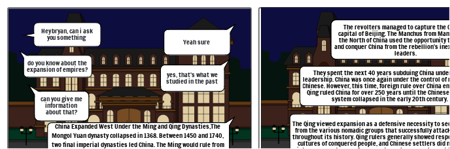
- do you know about the expansion of empires?
- Hey bryan, can i ask you something 
- can you give me information about that?
- The Ming dynasty collapsed in 1644 following a wide-scale famine. As conditions worsened, a peasant revolt led by a minor government official, Li Zicheng, broke out. 
- China Expanded West Under the Ming and Qing Dynasties,The Mongol Yuan dynasty collapsed in 1368. Between 1450 and 1740, two final imperial dynasties led China. The Ming would rule from 1368-1644, while the Qing would rule from 1644-1912
- yes, that's what we studied in the past
- Yeah sure
- The Qing viewed expansion as a defensive necessity to secure China from the various nomadic groups that successfully attacked China throughout its history. Qing rulers generally showed respect for the cultures of conquered people, and Chinese settlers did not flood into conquered areas. Conquered peoples were also not forced to adopt Chinese culture.
- The Mughal Empire (1525-1857) was the second significant Islamic power in India. Babur, a Muslim Turk who invaded India from the Northwest, established the dynasty after defeating the last Sultan of the Delhi Sultanate at the Battle of Panipat in 1526. At its height in the late 17th and early 18th centuries, the Mughal Empire encompassed nearly all of the Indian subcontinent.
- They spent the next 40 years subduing China under their leadership. China was once again under the control of non-ethnic Chinese. However, this time, foreign rule over China endured. The Qing ruled China for over 250 years until the Chinese imperial system collapsed in the early 20th century.
- The revolters managed to capture the Chinese capital of Beijing. The Manchus from Manchuria to the North of China used the opportunity to invade and conquer China from the rebellion’s inexperienced leaders. 
- The Ottoman EmpireBy the 14th century, the Christian Byzantine Empire had weakened, and the Ottoman Turks on Byzantium’s eastern borders slowly began to conquer portions of Byzantine territory. By 1453 all that remained of the once great Byzantine Empire was its capital city of Constantinople. In 1453, 80,000 troops led by Ottoman Sultan Mehmed laid siege to the city. Less than two months later, on May 29, 1453, the siege ended with an Ottoman victory. The Ottomans rebuilt Constantinople as the capital of the Ottoman Empire and named it Istanbul.
- The Safavid EmpireEstablished in 15th-century Persia, the Safavid Empire sat between the Ottoman Empire to the west and the Mughal Empire to the east.Like the Mughals and the Ottomans, the Safavid descended from Turkish ancestry. 
- The Ottoman Empire was the heartland of Sunni Islam and considered the Shia Islamic practices of the Safavid heretical (against proper Islam). 
- The religious divide between the Shia Safavid and the Sunni Ottoman empires was one main contributor.