

 Zaregistrujte se jako učitel
Unknown Story


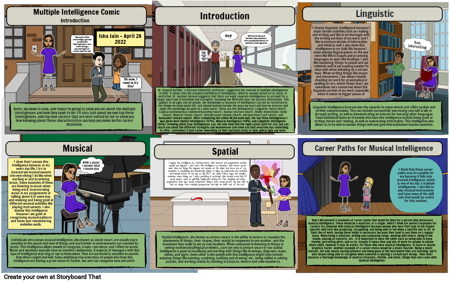
Storyboard Text
- Hello, my name is Isha, and today I'm going to show you all about the multiple intelligences and how they came to be! I'll also talk about my own top three intelligences, and top nine careers that are best suited for me to show you how knowing about these characteristics can help you make better career decisions.
- Multiple Intelligence Comic
- Introduction
- Because of the knowledge I gained on multiple intelligences, I now know being a psychologist is what's best for me!
- Isha Jain - April 26 2022
- Oh wow, I need to try this!
- Dr. Howard Gardner, a Harvard University professor, suggested the concept of multiple intelligences in 1983. It shows that the standard definition of intelligence, which is usually based on I.Q. tests, is restricted. Dr. Gardner instead suggests that there are eight separate intelligences to account for a larger spectrum of potential and strengths, including the different ways we process information. This applies to all ages and all people. Our knowledge or measure of intelligence can not be restricted to the things we know about life, but should instead include the ways we learn and how we process and apply the knowledge we gain on a daily basis. These are the intelligences: Linguistic (word smart), Logical-mathematical (number/reasoning smart), Spatial (picture smart), Bodily-Kinesthetic (body smart), Musical (music smart), Interpersonal (people smart), Intrapersonal (self smart), and Naturalist (nature smart). After completing the online MI job bank quiz, the top three intelligences I was given were Spatial Intelligence (97%), Musical Intelligence (94%) and Linguistic Intelligence (91%). Knowing about your intelligences can, not only help find the right career path for you, but can teach you about the different strengths and weaknesses and show you that everyone has something to offer, sometimes it just varies depending on their personal areas of skill; where they are most comfortable.
- Introduction
- Spatial 97%Musical 94%Linguistic 91%
- Hey!
- OMG its Dr. Howard Gardner, the professor who created the theory of multiple intelligences.
- Linguistic intelligence incorporates the capacity to comprehend and utilize spoken and written communication. This can include successfully expressing yourself orally or through writing, as well as demonstrating an interest for learning other languages. Some additional features of people who have this intelligence include being good at writing stories and reading, as well as memorizing information. This intelligence also allows us to be able to explain things well and give informative/persuasive speeches.
- I display linguistic intelligence because I enjoy certain activities such as reading and writing and like to be thorough with the writing portions of my work, and I like to incorporate lots of information and detail as well. I also show this intelligence in my daily life because I enjoy playing lingual games on the app store like Word Scapes and practicing languages on apps like Duolingo. I also like explaining things to people and am relatively well at persuading people I'm close with when debating on a certain topic. When writing things like essays and documents, I am always double checking my work for grammatical or spelling errors, which shows that I am sometimes very concerned about the linguistic portion of my work, especially when it comes to bigger pieces of writing.
- Linguistic
- Ooo, interesting
- Individuals who posses musical intelligence, also known as sound smart, are usually more sensitive to the sound and tone of things and work better in environments surrounded by music. This intelligence allows people to recognize, create, reproduce, and reflect on music. Music and emotions typically have an intuitive relationship. A majority of teenagers with this type of intelligence may sing or tap to themselves. They are particularly sensitive to sounds that others might overlook. Some additional characteristics of people who have this intelligence are having a great sense of rhythm, key and can recognize tone and pitch.
- I show that I posses this intelligence because, in my every day life, I try to incorporate musical aspects into everything I do like when working or just practicing music. Some examples of these are listening to music when doing work, incorporating music in my assignments or talking about it in some way, and enjoying and being good at different musical activities like playing instruments. I also display this intelligence because I am good at recognizing musical patterns and tones and remembering melodies easily.
- Musical
- WOW a piano! I wonder what I should play
- Spatial intelligence, also known as picture smart, is the ability to picture or visualize the placements of things, their shapes, their spatial arrangement to one another, and the movement they make to set up new locations. When compared to listening to things or solving mathematical/logical problems, a person who is picture smart or has spatial intelligence is good at visualizing and working with things like drawings, diagrams, maps, videos, and signs. Some other traits people with this intelligence might have include enjoying things like painting, sculpting, building and drawing, etc., being skilled in solving puzzles, and working mainly by thinking in pictures, texture and colors/patterns.
- Spatial
- I display this intelligence by working better when lessons and assignments include visuals and diagrams. I also show this intelligence by showing I take better notes when there are things like diagrams and visuals on the slides, and since one of my strengths is visualizing and remembering things, it helps me understand and remember the material better. In my day to day life, I can easily follow maps and visually remember where things are. I enjoy partaking in activities that include some kind of visual aspect such as painting, reading and writing for fun, designing, and doing assignments that have visual component. Being a more visual person can also help me look at things from multiple perspectives and help me think out of the box.
- Now I will present 2 examples of career paths that would be ideal for a person who possesses musical intelligence. These would be a musician, or a singer, which I think are perfect examples for careers for someone with musical intelligence because people who have that type of job require specific skill sets like producing, recognizing, and being able to tell when a specific key is off. In their line of work, having these skills is necessary because they tend to use them on a regular basis. When being a musician, writing and composing songs, working with others, being in the studio, playing at concerts, etc., it is important to have the skills such as being able to keep rhythm, perceiving pitch, and so on. Usually it takes time and lots of work for people to obtain these skills, however it may be easier, for those who have musical intelligence, to learn or maybe progress faster. Another example of a career choice would be a music teacher. Being a music teacher, not only means having patience and being good at the instrument they are teaching, but it also means being able to recognize when someone is playing a certain part wrong - they must possess a thorough knowledge of musical structure, rhythm, and notes, things that also come with musical intelligence.
- Career Paths for Musical Intelligence
- I think that these career paths may be suitable for me because it falls into musical intelligence, which is one of my top 3 multiple intelligences. I also like to play musical instruments and have some of the skill sets that would be useful for this position.
Vytvořeno přes 40 milionů storyboardů
K Vyzkoušení Není Potřeba Žádné Stahování, Žádná Kreditní Karta a Žádné Přihlášení!
