

 S'inscrire comme enseignant
Captain Computational


Texte du Storyboard
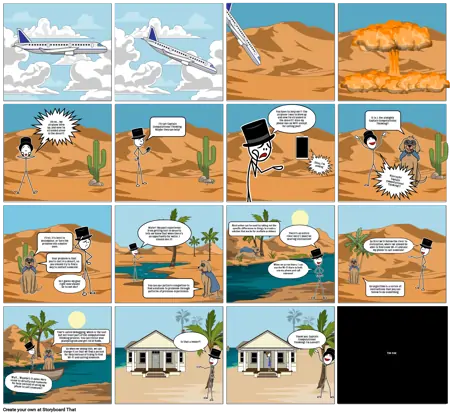
- Oh no... my airplane blew up, and now I'm stranded alone in the desert!
- I'll call Captain Computational Thinking. Maybe they can help!
- You have to help me!!! The airplane I was in blew up and now I'm stranded in the desert!! Also my phone has no WiFi except for calling you!!
- Okay, I'm coming
- It is I, the almighty Captain Computational Thinking!!
- Hooray for Captain Computational Thinking!!!
- First, it's best to decompose, or turn the problem into smaller ones.
- Your problem is that you're lost in a desert, so you should try to find a way to contact someone.
- So I guess my goal right now should be to not die?
- Water! My past experience from getting lost in deserts lets me know that when there's an opportunity for water, I should use it!
- You can use pattern recognition to find solutions to problems through patterns of previous experiences.
- Abstraction can be used by taking out the specific differences in things to create a solution that works for multiple problems
- There's an entire river here! I must be nearing civilization!
- When we arrive there, I can use the Wi-Fi there to both use my phone and call someone!
- An algorithm is a series of instructions that you can follow to do something.
- So first we'll follow the river to civilization, where we should be able to find some Wi-Fi and use my phone to call someone!
- That's called debugging, which is the last but not least part of the computational thinking process. You can revise your plan/program and get rid of flaws.
- Wait... Wouldn't it make more sense to directly ask someone for help instead of using my phone to call someone?
- So when we debug this, we can change it so that we find a person for help instead of trying to find Wi-Fi and calling someone.
- Is that a house?!
- Thank you, Captain Computational Thinking! I'm saved!!!
- The End
Plus de 40 millions de storyboards créés
Aucun Téléchargement, Aucune Carte de Crédit et Aucune Connexion Nécessaire Pour Essayer !
