

sELIKjfg WEIOPF H;iwufh OWIEFJwef


Texte du Storyboard
- Glisser: 1
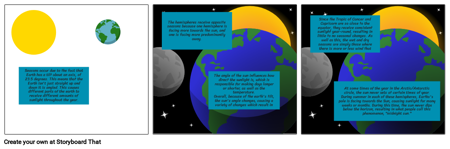
- Seasons occur due to the fact that Earth has a tilt about an axis, of 23.5 degrees. This means that the Earth isn't just straight up and down it is angled. This causes different parts of the earth to receive different amounts of sunlight throughout the year.
- Glisser: 2
- The hemispheres receive opposite seasons because one hemisphere is facing more towards the sun, and one is facing more predominantly away.
- The angle of the sun influences how direct the sunlight is, which is responsible for making days longer or shorter, as well as the temperature.Overall, because of the earth's tilt, the sun's angle changes, causing a variety of changes which result in the seasons.
- Glisser: 3
- Since the Tropic of Cancer and Capricorn are so close to the equator, they receive consistent sunlight year-round, resulting in little to no seasonal changes. As well as this, the wet and dry seasons are simply those where there is more or less wind that bring precipitation.
- At some times of the year in the Arctic/Antarctic circle, the sun never sets at certain times of year. During summer in each of these hemispheres, Earths's pole is facing towards the Sun, causing sunlight for many weeks or months. During this time, the sun never dips below the horizon, resulting in what people call this phenomenon, "midnight sun."