

Unknown Story


Texte du Storyboard
- How Adler Sees Me
- My brother has all of the responsibilities and my little sister is always spoiled. Where does that leave me?
- How Rogers Sees Me
- AP Statistics is so hard, I really need to work harder if I want to get an A on my report card.
- How Bandura Sees Me
- That is awesome! I am happy because you are happy!
- It is such a beautiful day outside and the coaches are in a great mood. I am so happy!
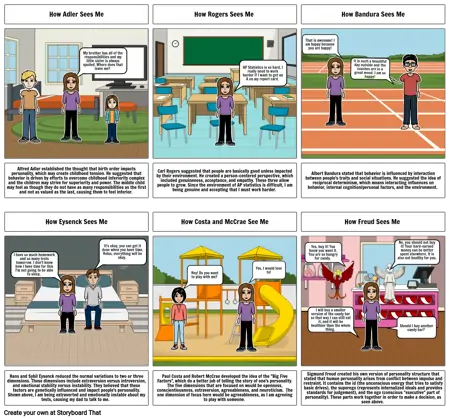
- Alfred Adler established the thought that birth order impacts personality, which may create childhood tension. He suggested that behavior is driven by efforts to overcome childhood inferiority complex and the children may strive for superiority and power. The middle child may feel as though they do not have as many responsibilities as the first and not as valued as the last, causing them to feel inferior.
- How Eysenck Sees Me
- I have so much homework and so many tests tomorrow. I don't know how I have time for this I'm not going to be able to sleep.
- It's okay, you can get it done when you have time. Relax, everything will be okay.
- Carl Rogers suggested that people are basically good unless impacted by their environment. He created a person-centered perspective, which included genuineness, acceptance, and empathy. These three allow people to grow. Since the environment of AP statistics is difficult, I am being genuine and accepting that I must work harder.
- How Costa and McCrae See Me
- Hey! Do you want to play with me?
- Yes, I would love to!
- Albert Bandura stated that behavior is influenced by interaction between people's traits and social situations. He suggested the idea of reciprocal determinism, which means interacting influences on behavior, internal cognition/personal factors, and the environment.
- How Freud Sees Me
- Yes, buy it! You know you want it. You are so hungry for candy.
- No, you should not buy it! Your hard-earned money can be better spent elsewhere. It is also not healthy for you.
- Hans and Sybil Eysenck reduced the normal variations to two or three dimensions. These dimensions include extraversion versus introversion, and emotional stability versus instability. They believed that these factors are genetically influenced and impact people's personality. Shown above, I am being extraverted and emotionally instable about my tests, causing my dad to talk to me.
- Paul Costa and Robert McCrae developed the idea of the "Big Five Factors", which do a better job of telling the story of one's personality. The five dimensions that are focused on would be openness, conscientiousness, extraversion, agreeableness, and neuroticism. The one dimension of focus here would be agreeableness, as I am agreeing to play with someone.
- Sigmund Freud created his own version of personality structure that stated that human personality arises from conflict between impulse and restraint. It contains the id (the unconscious energy that tries to satisfy basic drives), the superego (represents internalized ideals and provides standards for judgement), and the ego (conscious "executive" part of personality). These parts work together in order to make a decision, as seen above.
- I will buy a smaller version of the candy bar so that way I can still eat it, and it will be healthier than the whole thing.
- Should I buy another candy bar?