

International Women's Day Challenge - Comic Strip about the COVID-19 mRNA v


स्टोरीबोर्ड पाठ
- फिसलना: 1
-
- SOAP
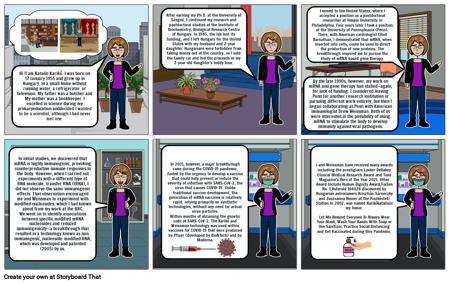
- Hi !I am Katalin Karikó. I was born on 17 January 1955 and grew up in Hungary, in a small home without running water, a refrigerator, or television. My father was a butcher and My mother was a bookkeeper. I excelled in science during my primaryeducation anddecided I wanted to be a scientist, although I had never met one.
- फिसलना: 6
- By the late 1990s, however, my work on mRNA and gene therapy had stalled—again, for lack of funding. I considered leaving Penn for another research institution or pursuing different work entirely, but then I began collaborating at Penn with American immunologist Drew Weissman. Both of us were interested in the possibility of using mRNA to stimulate the body to develop immunity against viral pathogens.
- फिसलना: 0
- I and Weissman have received many awards including the prestigious Lasker-DeBakey Clinical Medical Research Award and Time Magazine's Hero of the Year 2021. Other Award Include Human Dignity Award,Forbes No. 1.Asteroid 166028 discovered by Hungarian astronomers Krisztián Sárneczky and Zsuzsanna Heiner at the Piszkéstető Station in 2002, was named Karikókatalinin my honor.Let Me Remind Everyone To Always Wear Your Mask, Wash Your Hands With Soap or Use Sanitizer, Practice Social Distancing and Get Vaccinated during this Pandemic.
- After earning my Ph.D. at the University of Szeged, I continued my research and postdoctoral studies at the Institute of Biochemistry, Biological Research Centre of Hungary. In 1985, the lab lost its funding, and I left Hungary for the United States with my husband and 2-year daughter. Hungarians were forbidden from taking money out of the country, so I sold the family car and hid the proceeds in my 2-year-old daughter’s teddy bear.
- I moved to the United States, where I accepted a position as a postdoctoral researcher at Temple University in Philadelphia. Four years later I took a position at the University of Pennsylvania (Penn). There, with American cardiologist Elliot Barnathan, I demonstrated that mRNA, when inserted into cells, could be used to direct the production of new proteins. The breakthrough inspired me to pursue the study of mRNA-based gene therapy.
- In initial studies, we discovered that mRNA is highly immunogenic, provoking counterproductive immune responses in the body. However, when I carried out experiments with a different type of RNA molecule, transfer RNA (tRNA), I did not observe the same immunogenic effects. That observation encouraged me and Weissman to experiment with modified nucleosides, which I had known about from my work at the BRC.We went on to identify associations between specific modified mRNA nucleosides and reduced immunogenicity—a breakthrough that resulted in a technology known as non-immunogenic, nucleoside-modified RNA, which was developed and patented (2005) by us.
- In 2021, however, a major breakthrough came during the COVID-19 pandemic, fueled by the urgency to develop a vaccine that could help prevent or reduce the severity of infection with SARS-CoV-2, the virus that causes COVID-19. Unlike traditional vaccine development, the generation of mRNA vaccines is relatively rapid, relying primarily on synthetic technologies, without any need for actual virus particles. Within months of obtaining the genetic code of SARS-CoV-2, The Karikó and Weissman technology was used within vaccines for COVID-19 that were produced by Pfizer (developed by BioNTech) and by Moderna.
40 मिलियन से अधिक स्टोरीबोर्ड बनाए गए
कोई डाउनलोड नहीं, कोई क्रेडिट कार्ड नहीं, और कोशिश करने के लिए किसी लॉगिन की आवश्यकता नहीं है!
