

TransportProject1


Storyboard Szöveg
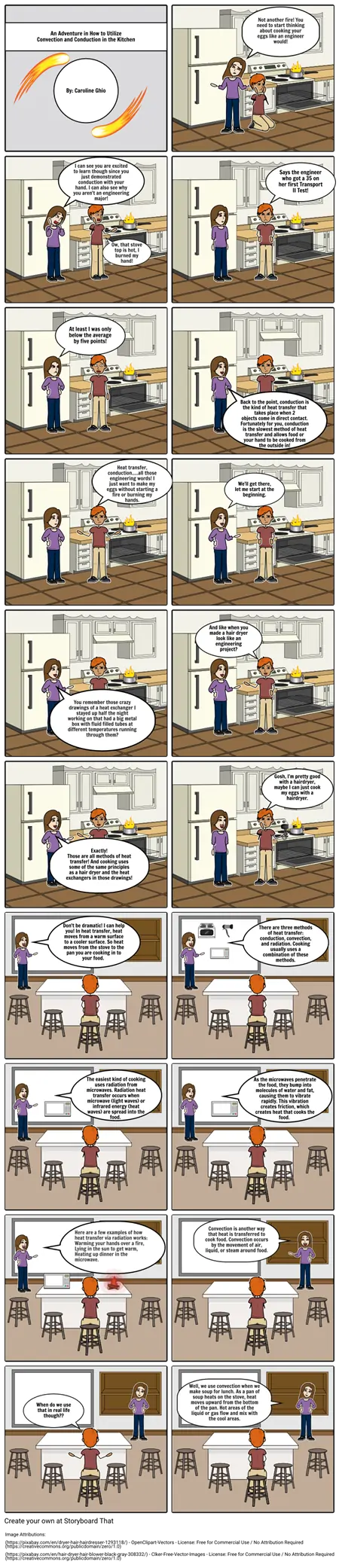
- An Adventure in How to Utilize Convection and Conduction in the Kitchen
- By: Caroline Ghio
- Not another fire! You need to start thinking about cooking your eggs like an engineer would!
- I can see you are excited to learn though since you just demonstrated conduction with your hand. I can also see why you aren't an engineering major!
- Ow, that stove top is hot, I burned my hand!
- Says the engineer who got a 35 on her first Transport II Test!
- At least I was only below the average by five points!
- Back to the point, conduction is the kind of heat transfer that takes place when 2 objects come in direct contact. Fortunately for you, conduction is the slowest method of heat transfer and allows food or your hand to be cooked from the outside in!
- Heat transfer, conduction.....all those engineering words! I just want to make my eggs without starting a fire or burning my hands.
- We’ll get there, let me start at the beginning.
- You remember those crazy drawings of a heat exchanger I stayed up half the night working on that had a big metal box with fluid filled tubes at different temperatures running through them?
- And like when you made a hair dryer look like an engineering project?
- Exactly! Those are all methods of heat transfer! And cooking uses some of the same principles as a hair dryer and the heat exchangers in those drawings!
- Gosh, I’m pretty good with a hairdryer, maybe I can just cook my eggs with a hairdryer.
- Don't be dramatic! I can help you! In heat transfer, heat moves from a warm surface to a cooler surface. So heat moves from the stove to the pan you are cooking in to your food.
- There are three methods of heat transfer: conduction, convection, and radiation. Cooking usually uses a combination of these methods.
- The easiest kind of cooking uses radiation from microwaves. Radiation heat transfer occurs when microwave (light waves) or infrared energy (heat waves) are spread into the food.
- As the microwaves penetrate the food, they bump into molecules of water and fat, causing them to vibrate rapidly. This vibration creates friction, which creates heat that cooks the food.
- Here are a few examples of how heat transfer via radiation works: Warming your hands over a fire, Lying in the sun to get warm, Heating up dinner in the microwave.
- Convection is another way that heat is transferred to cook food. Convection occurs by the movement of air, liquid, or steam around food.
- When do we use that in real life though??
- Well, we use convection when we make soup for lunch. As a pan of soup heats on the stove, heat moves upward from the bottom of the pan. Hot areas of the liquid or gas flow and mix with the cool areas.
A Fényképek Forrásmegjelölések
- https://pixabay.com/en/dryer-hair-hairdresser-1293118/ - OpenClipart-Vectors - (Engedély Free for Commercial Use / No Attribution Required (https://creativecommons.org/publicdomain/zero/1.0) )
- https://pixabay.com/en/hair-dryer-hair-blower-black-gray-308332/ - Clker-Free-Vector-Images - (Engedély Free for Commercial Use / No Attribution Required (https://creativecommons.org/publicdomain/zero/1.0) )