

Untitled Storyboard


Siužetinės Linijos Tekstas
- Skaidrė: 1
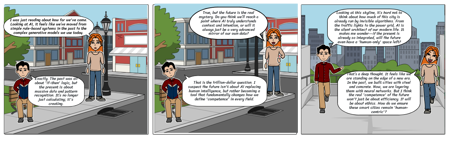
- I was just reading about how far we've come. Looking at AI, it feels like we’ve moved from simple rule-based systems in the past to the complex generative models we use today.
- Exactly. The past was all about 'if-then' logic, but the present is about massive data and pattern recognition. It’s no longer just calculating; it's creating.
- Skaidrė: 2
- True, but the future is the real mystery. Do you think we’ll reach a point where AI truly understands context and intention, or will it always just be a very advanced mirror of our own data?
- That is the trillion-dollar question. I suspect the future isn't about AI replacing human intelligence, but rather becoming a tool that fundamentally changes how we define 'competence' in every field.
- Skaidrė: 3
- Looking at this skyline, it’s hard not to think about how much of this city is already run by invisible algorithms. From the traffic lights to the power grid, AI is the silent architect of our modern life. It makes me wonder—if the present is already so integrated, will the future even have a 'human-only' space left?
- That’s a deep thought. It feels like we are standing on the edge of a new era. In the past, we built cities with steel and concrete. Now, we are layering them with neural networks. But I think the real 'competence' of the future won't just be about efficiency. It will be about ethics. How do we ensure these smart cities remain 'human-centric'?