

 Registruotis kaip mokytojas
Regular and irregular verbs


Siužetinės Linijos Tekstas
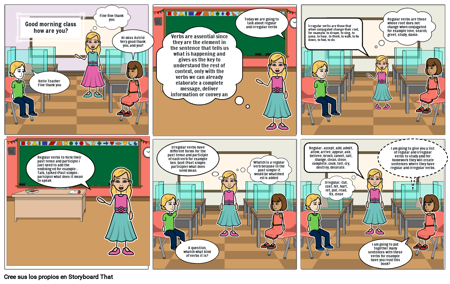
- Good morning class how are you?
- Hello Teacher Fine thank you
- Fine fine thank you
- Hi miss Astrid Very good thank you, and you?
- Verbs are assential since they are the element in the sentence that tells us what is happening and gives us the key to understand the rest of context, only with the verbs we can already elaborate a complete message, deliver information or convey an idea.
- Today we are going to talk about regular and irregular verbs
- Irregular verbs are those that when conjugated change their root, for example, to dream, to sing, to jump, to hear, to think, to walk, to lie down, to feel, to do.
- Regular verbs are those whose root does not change when conjugated for example love, search, greet, study, dance.
- Regular verbs to form their past tense and participle i just need to add the endining ed for example : Talk, talked (Past simple- paricipio) what does it mean to speak
- Irregular verbs have different forms for the past tense and participle of each verb for example Sen, Sent (Past simple. participle) what does send mean.
- A question, whatch what kind of verbs it is?
- Whatch is a regular verb because in the past simple it would be whatched ed is added
- Regular: accept, add, admit, allow, arrive, appear, ask, believe, brush, cancel, call, change, clean, close, complete, cook, tell, cry, destroy, decorate.
- Irregular: Cut, cost, hit, hurt, let, put, read, fix, close
- I am going to put together many sentences with these verbs for example have you read this book?
- I am going to give you a list of regular and irregular verbs to study amd for homework they will create sentences where they have regular and irregular verbs.
Sukurta daugiau nei 40 milijonų siužetinių lentų
Nereikia Atsisiuntimų, Nereikia Kredito Kortelės ir Nereikia Prisijungti!
