

 Registruotis kaip mokytojas
Unknown Story


Siužetinės Linijos Tekstas
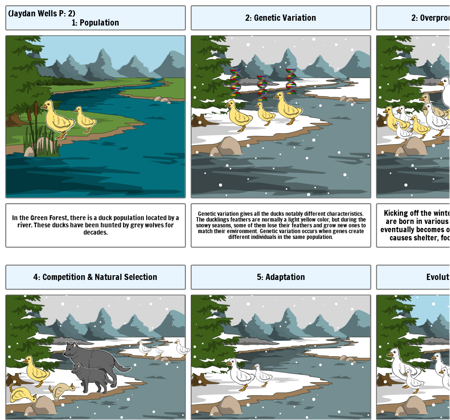
- (Jaydan Wells P: 2) 1: Population
- 2: Genetic Variation
- 2: Overproduction of Offspring
- In the Green Forest, there is a duck population located by a river. These ducks have been hunted by grey wolves for decades.
- 4: Competition & Natural Selection
- Genetic variation gives all the ducks notably different characteristics. The ducklings feathers are normally a light yellow color, but during the snowy seasons, some of them lose their feathers and grow new ones to match their environment. Genetic variation occurs when genes create different individuals in the same population.
- 5: Adaptation
- Kicking off the winter season, many new ducklings are born in various amounts of colors. The forest eventually becomes overpopulated with ducks, which causes shelter, food, and resources to run out.
- Evolution Has Occured
- The white-feathered ducks are harder for its predator, the grey wolves, to hunt. The ducks with the whitest feathers can hide easier than the ducks with yellow and tan feathering. It's natural selection where the best suited for the snowy environment will survive and reproduce in a safe environment.
- White feathered ducks were more likely to produce offspring with other white feathered ducks. After, various generations of natural selection, the population became filled w/ mostly white feathered ducks.
- Evolution can happen quickly or slowly in an environment depending on the size of change and genetics in population. The genetic differences can include a short/long tail, light/dark fur, short/long back legs, big/small ears etc. In this environment specifically, the dominant genetic trait is white fur. The environment of the snowy forest gives a sort of layout to whom can adapt , survive and create offspring.
Sukurta daugiau nei 40 milijonų siužetinių lentų
Nereikia Atsisiuntimų, Nereikia Kredito Kortelės ir Nereikia Prisijungti!
