

 Registruotis kaip mokytojas
Italian Unification (slides #1 - #6)


Siužetinės Linijos Tekstas
- #1 Background of Italy
- #2 Fall of Napoleon
- ... So you cool with getting Italy?
- Yeah, it's not like they can do anything about it.
- #3 The Beginnings of Revolution
- ...
- CARBONARIMeetingPlace
- For real!? Me too!
- Ay, I kinda feel like doing something bout it.
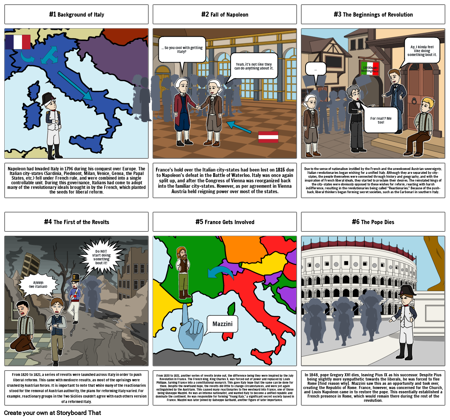
- Napoleon had Invaded Italy in 1796 during his conquest over Europe. The Italian city-states (Sardinia, Piedmont, Milan, Venice, Genoa, the Papal States, etc.) fell under French rule, and were combined into a single controllable unit. During this governance, Italians had come to adopt many of the revolutionary ideals brought in by the French, which planted the seeds for liberal reform.
- #4 The First of the Revolts
- Do NOT start doing somethng bout it!
- France’s hold over the Italian city-states had been lost on 1815 due to Napoleon’s defeat in the Battle of Waterloo. Italy was once again split up, and after the Congress of Vienna was reorganized back into the familiar city-states. However, as per agreement in Vienna Austria held reigning power over most of the states.
- #5 France Gets Involved
- Due to the sense of nationalism instilled by the French and the unwelcomed Austrian sovereignty, Italian revolutionaries began wishing for a unified Italy. Although they are separated by city-states, the people themselves were connected through history and geography, and with the inspiration of French liberal ideals, they started to proclaim their desires. The reinstated kings of the city-states were obviously opposed to these wishes for reform, reacting with harsh indifference, resulting in the revolutionaries being called “Reactionaries.” Because of the push-back, liberal thinkers began forming secret societies, such as the Carbonari in southern Italy.
- #6 The Pope Dies
- From 1820 to 1821, a series of revolts were launched across Italy in order to push liberal reforms. This came with mediocre results, as most of the uprisings were crushed by Austrian forces. It is important to note that while many of the reactionaries stood for the removal of Austrian authority, the plans for reforming Italy varied. For example, reactionary groups in the Two Sicilies couldn’t agree with each others version of a reformed Italy.
- Ahhhh(we italian)
- From 1830 to 1831, another series of revolts broke out, the difference being they were inspired by the July Revolution in France. The French king, King Charles X, was forced out of power and replaced by Louis Philippe, turning France into a constitutional monarch. This gave Italy hope that the same can be done for them. Despite the newfound hope, the revolts did little to change circumstances, and were yet again extinguished by the Austrians. This caused many reactionaries to flee westward into France, one of those being Giuseppe Mazzini. He was an intense nationalist, and wanted Italy to become a unified republic and dominate the continent. He was responsible for forming “Young Italy,” a significant secret society based in France. Mazzini was later joined by Guiseppe Garibaldi, another figure of later importance.
- Mazzini
- In 1848, pope Gregory XVI dies, leaving Pius IX as his successor. Despite Pius being slightly more sympathetic towards the liberals, he was forced to flee Rome [find reason why]. Mazzini saw this as an opportunity and took over, creating the Republic of Rome. France, however, was concerned for the Church, and Louis Napoleon came in to restore the pope. This essentially established a French presence in Rome, which would remain there during the rest of the revolution.
Sukurta daugiau nei 40 milijonų siužetinių lentų
Nereikia Atsisiuntimų, Nereikia Kredito Kortelės ir Nereikia Prisijungti!
