

 Registruotis kaip mokytojas
Sonnet 30 Evaluation (CWS)


Siužetinės Linijos Tekstas
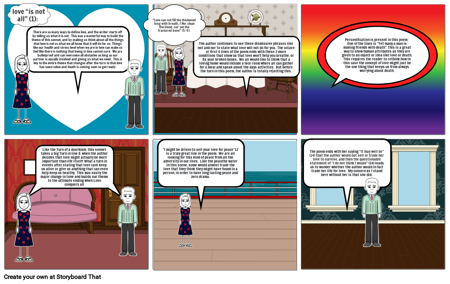
- love “is not all” (1): 
- There are so many ways to define love, and the writer starts off by telling us what it is not.  This was a masterful way to build the theme of this sonnet, and by making us think about all the things that love is not vs what we all know that it will do for us. Things like our health and stress level when we are in love can make us feel like there is nothing that being in love cannot cure.  We are bulletproof and can overcome all obstacles as long as our partner is equally involved and giving us what we need.  This is key to the entire theme that changes after the turn to that love has some value and death is coming soon so get ready.
- “Love can not fill the thickened lung with breath, / Nor clean the blood, nor set the fractured bone” (5-6).
- The author continues to use these dismissive phrases like not and nor to state what love will not do for you.  The octave or first 6 lines of the poem ends with these 2 more conditions that show us that love won't help you breathe, or fix your broken bones.  We all would like to think that a loving home would include a nice room where all can gather for a meal and speak about the days activities.  But before the turn in this poem, the author is totally rejecting this.
- Personification is present in this poem.  One of the lines is "Yet many a man is making friends with death". This is a great way to show human attributes as they are given to an object or idea like love or death. This requires the reader to rethink how in this case the concept of love might just be the one thing that keeps us from always worrying about death.
- Like the Turn of a doorknob, this sonnet takes a big Turn in line 8  when the author decides that love might actually be more important than life itself! What a turn in events after stating that love cant keep us alive or give us anything that can even help keep us healthy.  This was easily the major change in tone and builds our theme to the ultimate ending when Love conquers all
- "I might be driven to sell your love for peace"12 is a truly great line in the poem.  We are all looking for this kind of peace from all the adversity in our lives.  Like the peaceful water in this scene, some would almost trade the love that they think they might have found in a person, in order to have long lasting peace and zero drama.
- The poem ends with her saying "It may well be” (14) that the author would not sell or trade her love to survive, and then the questionable statement of “I do not think I would” (14) leads us to wonder whether the author would in fact trade her life for love.  My concern as I stand here without her is that she did.
Sukurta daugiau nei 40 milijonų siužetinių lentų
Nereikia Atsisiuntimų, Nereikia Kredito Kortelės ir Nereikia Prisijungti!
