

War of 1812


Siužetinės Linijos Tekstas
- Cause of the War
- Trouble with Native Americans
- Land battles
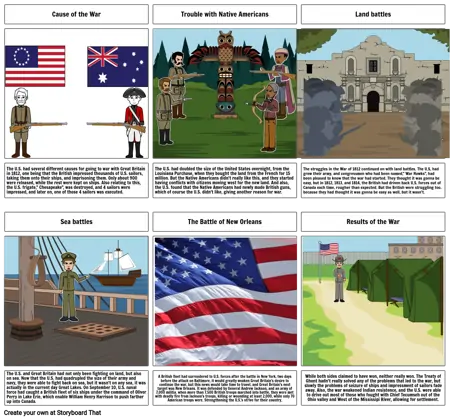
- The U.S. had several different causes for going to war with Great Britain in 1812, one being that the British impressed thousands of U.S. sailors, taking them onto their ships, and imprisoning them. Only about 900 were released, while the rest were kept on ships. Also relating to this, the U.S. frigate," Chesapeake", was destroyed, and 4 sailors were impressed, and later on, one of those 4 sailors was executed.
- Sea battles
- The U.S. had doubled the size of the United States overnight, from the Louisiana Purchase, when they bought the land from the French for 15 million. But the Native Americans didn't really like this, and they started having conflicts with citizens moving west for the new land. And also, the U.S. found that the Native Americans had newly made British guns, which of course the U.S. didn't like, giving another reason for war.
- The Battle of New Orleans
- The struggles in the War of 1812 continued on with land battles. The U.S. had grew their army, and congressmen who had been named," War Hawks", had been pleased to know that the war had started. They thought it was gonna be easy, but in 1812, 1813, and 1814, the British had driven back U.S. forces out of Canada each time, rougher than expected. But the British were struggling too, because they had thought it was gonna be easy as well, but it wasn't.
- Results of the War
- The U.S. and Great Britain had not only been fighting on land, but also on sea. Now that the U.S. had quadrupled the size of their army and navy, they were able to fight back on sea, but it wasn't on any sea, it was actually in the current day Great Lakes. On September 10, U.S. naval force had caught a British fleet of six ships under the command of Oliver Perry in Lake Erie, which enable William Henry Harrison to push farther up into Canada.
- A British fleet had surrendered to U.S. forces after the battle in New York, two days before the attack on Baltimore, it would greatly weaken Great Britain's desire to continue the war, but this news would take time to travel, and Great Britain's next target was New Orleans. It was defended by General Andrew Jackson, and an army of 7,000 militia. when more than 7,500 British troops marched into battle, they were met with deadly fire from Jackson's troops, killing or wounding at least 2,000, while only 70 American troops were. Strengthening the U.S.'s strive for their country.
- While both sides claimed to have won, neither really won. The Treaty of Ghent hadn't really solved any of the problems that led to the war, but slowly the problems of seizure of ships and impressment of sailors fade away. Also, the war weakened Indian resistence, and the U.S. were able to drive out most of those who fought with Chief Tecumseh out of the Ohio valley and West of the Mississipi River, allowing for settlement.