

 Registruotis kaip mokytojas
Memory Lane: The Exam Edition


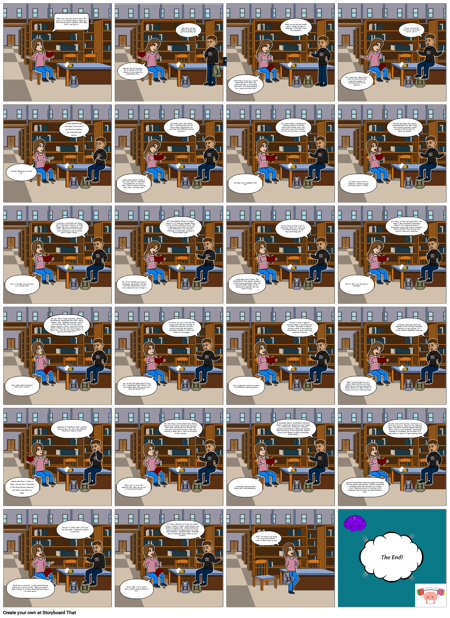
Siužetinės Linijos Tekstas
- Skaidrė: 1
- There is no way I am going to pass this exam. It is so hard trying to figure out how memory and its systems work. Why can't I just get it!
- Skaidrė: 2
- Hey Leah, are you okay? It seems like you're stressing out.
- Hey RJ. No, I'm having a lot of trouble with this chapter for my cognitive psychology class.
- Skaidrė: 3
- What are you having trouble with? I might be able to help you, I took that class last semester.
- I don't know if you can. I don't understand all of these big words and what is associated with what. I've been studying for a week and a half now!
- Skaidrė: 4
- C'mon, at least let me try. It can't hurt at all, can it?
- No, I guess not. Okay, fine. I can't for the life of me grasp the concept of memory and all of its systems!
- Skaidrė: 5
- I could definitely help with that! It was one of my favorite chapters, you found the right person.
- Really? Thank you so much Rj.
- Skaidrė: 6
- Of course. Now, first things first is breaking down how our brain stores information. Do you know the different memory systems?
- I know what they're called, I just can't seem to remember the definitions to each of them. There's sensory, working, short-term, and long-term.
- Skaidrė: 7
- Yes, great! Okay, starting with sensory memory. It briefly takes in how things look, feel, and smell in your surroundings. It lasts for less than a second.
- Oh okay, like a snapshot kind of?
- Skaidrė: 8
- Exactly like that! See, you're already getting this. Now, short term memory can hold a small amount of information for about 30 seconds.
- So that's more of like a clipboard, I think I may be starting to get it a little.
- Skaidrė: 9
- I told you I could help out! Okay, next is long term memory. It keeps things like facts, experiences, and skills. There isn't a limit on how much information can be stored and it's kept forever.
- Got it. So that one acts more as a storage room.
- Skaidrė: 10
- Yes! Keep finding things to connect these to, it'll help you remeber them! Lastly, we have working memory. This is where you brain holds and works with information. For example, following a recipe while cooking or doing mental math.
- Oh, so it's literally your brain's workspace. You process and deal with the information in real time instead of just storing it.
- Skaidrė: 11
- You're really starting to get it, Leah! Now, there are a few parts of working memory, do you know what they are?
- I only know two of them. The phonolgocial loop repeats sounds or words in your word head. Also, the episodic buffer brings all the information together into one event or story.
- Skaidrė: 12
- It's okay, at least you know those. One other is the visuospatial sketchpad which is for imaging pictures or directions. Lastly, the central executive which is kind of like the boss and controls what gets attention.
- Got it, that's not too hard to remember.
- Skaidrė: 13
- Ah, yes. There's false memories, which is remembering something that didn't really happen. Also, flashbulb memories, which are memories that feel real but aren't always accurate. There's even familiarity which is things that can feel true even if they're not. Like the false fame effect, if you've ever heard of it.
- Now, what about memories that aren't correct?
- Skaidrė: 14
- Of course. He was a man who had surgery that left him not able to make new memories. He did a puzzle every day and couldn't remember learning it, but he got better at it everyday.
- Yes, we did talk about that in class, but I completely forgot about it. We also talked about the case of H.M., have you heard of it?
- Skaidrė: 15
- You got it. One is explicit memory, which is recalling facts or events. The other is implicit memory, which is basically the unconscious, or some would say, automatic memory.
- Yes! It showed scientists we have two different memory systems.
- Skaidrė: 16
- You know, where you learn also depends on how well you remember and has its own system. It's called context-dependent memory.
- Yeah, I do know that one. It's about where and how you learn affecting how well you remember. Makes sense as to why I forget so much as soon as I leave my room.
- Skaidrė: 17
- Speaking of forgetting, that's another thing we have to cover, the different theories of why we forget.
- I know that there is three of them, the one that I remember is the decay theory. Memories will fade if you don't use them.
- Skaidrė: 18
- Yup, the others are the interference theory and retrieval failure. Interference theory is that newer information can disrupt old memories. Retrieval failure is when the memory is there, but it can't be accessed in the moment.
- Okay, got it. So on the opposite side, what can we use to learn and remember?
- Skaidrė: 19
- To remember there's maintenance rehearsal which is repeating information and it keeps it in short-term. Elaborative rehearsal connects information to things you already know and moves it into long-term. There's even certain things to help us remember things better.
- I remember learning about those tools, like mnemonics.
- Skaidrė: 20
- Exactly. Now with learning, sometimes we don't even mean to. There are two different types. Incidental learning happens when you don't mean to learn anything. Intentional learning is on purpose, you're aware of it, and expect to need it in your memory later
- We just learned about that last week! It includes the two processing systems. Shallow processing is thinking about the material on a surface level. Deep processing is focusing on the meaning of the material and understanding it more.
- Skaidrė: 21
- You got it. Well, that's all I got for you Leah. I think you'e gonna crush this!
- Thank you so much RJ, I really appreciate you helping me with all of this. When you break it down simpler, it's really interesting and makes a lot more sense!
- Skaidrė: 22
- Of course. Memory isn't just for school tests, it helps us learn, make choices, and handle everyday tasks. Understanding how memory works can improve how we study, solve problems, and build habits. Knowing how to remember better helps us live smarter.
- You're right, I'm so glad I have a better understanding of this.
- Skaidrė: 23
- Well, it's time to go study in a classroom and put some of those tools to use!
- Skaidrė: 24
- The End!
Sukurta daugiau nei 40 milijonų siužetinių lentų
Nereikia Atsisiuntimų, Nereikia Kredito Kortelės ir Nereikia Prisijungti!
