

Unknown Story


Siužetinės Linijos Tekstas
- Jacey Willhelm P:31:Population
- 2: Genetic Variation
- 3: Overproduction of Offspring
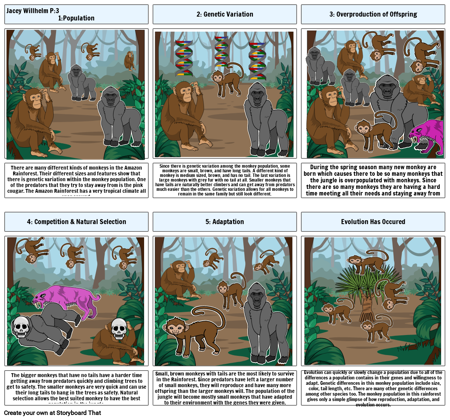
- There are many different kinds of monkeys in the Amazon Rainforest. Their different sizes and features show that there is genetic variation within the monkey population. One of the predators that they try to stay away from is the pink cougar. The Amazon Rainforest has a very tropical climate all year around.
- 4: Competition & Natural Selection
- Since there is genetic variation among the monkey population, some monkeys are small, brown, and have long tails. A different kind of monkey is medium sized, brown, and has no tail. The last variation is large monkeys with grey fur with no tail at all. Smaller monkeys that have tails are naturally better climbers and can get away from predators much easier than the others. Genetic variation allows for all monkeys to remain in the same family but still look different.
- 5: Adaptation
- During the spring season many new monkey are born which causes there to be so many monkeys that the jungle is overpopulated with monkeys. Since there are so many monkeys they are having a hard time meeting all their needs and staying away from predators.
- Evolution Has Occured
- The bigger monkeys that have no tails have a harder time getting away from predators quickly and climbing trees to get to safety. The smaller monkeys are very quick and can use their long tails to hang in the trees as safety. Natural selection allows the best suited monkey to have the best population in the jungle.
- Small, brown monkeys with tails are the most likely to survive in the Rainforest. Since predators have left a larger number of small monkeys, they will reproduce and have many more offspring than the larger monkeys will. The population of the jungle will become mostly small monkeys that have adapted to their environment with the genes they were given.
- Evolution can quickly or slowly change a population due to all of the differences a population contains in their genes and willingness to adapt. Genetic differences in this monkey population include size, color, tail length, etc. There are many other genetic differences among other species too. The monkey population in this rainforest gives only a simple glimpse of how reproduction, adaptation, and evolution occurs.