

Unknown Story


Tekst Storyboardowy
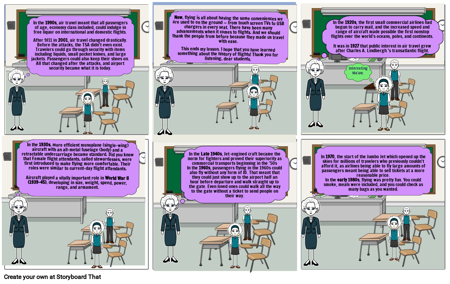
- In the 1990s, air travel meant that all passengers of age, economy class included, could indulge in free liquor on international and domestic flights. After 9/11 in 2001, air travel changed drastically. Before the attacks, the TSA didn't even exist. Travelers could go through security with items including liquids, small pocket knives, and large jackets. Passengers could also keep their shoes on. All that changed after the attacks, and airport security became what it is today.
- Now, flying is all about having the same conveniences we are used to on the ground — from touch screen TVs to USB chargers in every seat. There have been many advancements when it comes to flights. And we should thank the people from before because they made us travel with ease. This ends my lesson. I hope that you have learned something about the history of flights! Thank you for listening, dear students.
- 1912 - Ferdinand Graf von Zeppelin set up the first commercial airline, using a form of the dirigible to transportmore than 34,000 passengers before World War I.
- In the 1920s, the first small commercial airlines had begun to carry mail, and the increased speed and range of aircraft made possible the first nonstop flights over the world’s oceans, poles, and continents.It was in 1927 that public interest in air travel grew after Charles A. Lindbergh 's transatlantic flight.
- Interesting Ma’am.
- In the 1930s, more efficient monoplane (single-wing) aircraft with an all-metal fuselage (body) and a retractable undercarriage became standard. Did you know that Female flight attendants, called stewardesses, were first introduced to make flying more comfortable. Their roles were similar to current-day flight attendants. Aircraft played a vitally important role in World War II (1939–45), developing in size, weight, speed, power, range, and armament.
- In the Late 1940s, Jet-engined craft became the norm for fighters and proved their superiority as commercial transports beginning in the ’50sIn the 1960s, passengers flying in the 1960s could also fly without any form of ID. That meant that they could just show up to the airport half an hour before departure and walk straight up to the gate. Even loved ones could walk all the way to the gate without a ticket to send people on their way.
- In 1970, the start of the Jumbo Jet which opened up the skies for millions of travelers who previously couldn't afford it, as airlines being able to fly large amounts of passengers meant being able to sell tickets at a more reasonable price. In the early 1980s, flying was pretty fun. You could smoke, meals were included, and you could check as many bags as you wanted.