

classification of living things


Tekst Storyboardowy
- Living things are divided into five kingdoms: animal, plant, fungi, protist and monera
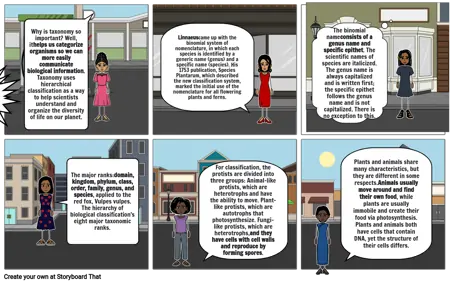
- Why is taxonomy so important? Well, it helps us categorize organisms so we can more easily communicate biological information. Taxonomy uses hierarchical classification as a way to help scientists understand and organize the diversity of life on our planet.
- Linnaeus came up with the binomial system of nomenclature, in which each species is identified by a generic name (genus) and a specific name (species). His 1753 publication, Species Plantarum, which described the new classification system, marked the initial use of the nomenclature for all flowering plants and ferns.
- The binomial name consists of a genus name and specific epithet. The scientific names of species are italicized. The genus name is always capitalized and is written first; the specific epithet follows the genus name and is not capitalized. There is no exception to this.
- The major ranks: domain, kingdom, phylum, class, order, family, genus, and species, applied to the red fox, Vulpes vulpes. The hierarchy of biological classification's eight major taxonomic ranks.
- For classification, the protists are divided into three groups: Animal-like protists, which are heterotrophs and have the ability to move. Plant-like protists, which are autotrophs that photosynthesize. Fungi-like protists, which are heterotrophs, and they have cells with cell walls and reproduce by forming spores.
- Plants and animals share many characteristics, but they are different in some respects. Animals usually move around and find their own food, while plants are usually immobile and create their food via photosynthesis. Plants and animals both have cells that contain DNA, yet the structure of their cells differs.