

A7: Language Development - Taylah Bailey


Tekst Storyboardowy
- Slajd: 1
- Louise (Mom): Aww! Are you telling me about your morning? Yes, you sure are!
- Maya: Ahhh...Ooo...
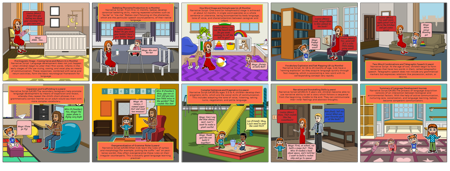
- Pre-linguistic Stage — Cooing Serve-and-Return (0–6 Months)Narrative Script: Language development does not just happen when children begin to utter their first words. Infants in the early stages of life use crying, cooing, and vocal play as means of communication. These responses, combined with serve and return activities, form the basic neurological framework for language.
- Slajd: 2
- Babbling Phoneme Production (6–11 Months)Narrative Script: From 6 to 11 months, babies develop canonical babbling skills, making repeated syllables such as “ba-ba” or “ma-ma.” Babies start focusing on the phonemes, which are the particular speech sound patterns, of their native language.
- Louise (Mom): Baba? Do you want your bottle? Here's your bottle, Maya!
- Maya: Ma-ma! Ba-ba!
- Slajd: 3
- One-Word Stage and Holophrases (12–18 Months)Narrative Script: One-word (or holophrastic) stage is achieved at about 12 months. A single word operates as a whole sentence or utterance, being accompanied by body language, tone of voice, and shared attention between caregiver and infant.
- Louise (Mom): You see the beach ball! Do you want mommy to roll the ball to you?
- Maya: (Points at ball) Ball!
- Slajd: 4
- Louise (Mom): Look, Maya! What is this animal in the book?
- Louise (Mom): Yes, good job! It's a cute little puppy going woof!
- Maya: Puppy! Puppy woof!
- Vocabulary Explosion and Fast Mapping (18–24 Months)Narrative Script: At 18 to 24 months of age, kids have a naming explosion as they acquire language quickly through fast mapping, which is associating a new word with its corresponding concept very rapidly.
- Slajd: 5
- Louise (Mom): You want more apple juice? Let's go to the kitchen and get some more!
- Maya: More juicy! Mommy go!
- Two-Word Combinations and Telegraphic Speech (2 years)Narrative Script: At the age of two, children begin to form sentences that have two words in them, called telegraphic speech. Telegraphic speech does not include any grammatical markers but expresses relations like possession, action, or desires.
- Slajd: 6
- Expansion and Scaffolding (2.5 years)Narrative Script: The secondary caregivers help promote language development by means of expansion and recast, whereby they repeat the child’s short phrases in a grammatically correct manner as an adult would say them with more complex vocabulary.
- Miss B (teacher): Yes, Maya! The paper plane is flying very high!
- Maya: Plane go fly!
- Slajd: 7
- Miss B (teacher): Wow, you ran so fast and you saw two little mice in the garden? That sounds like fun!
- Maya: At recess, I runned super fast and seed two mouses!
- Overgeneralization of Grammar Rules (3 years)Narrative Script: When kids learn the rules of syntax and morphology (for example, putting the suffix -ed on past-tense words), they often overgeneralize these rules on their irregular counterparts. This is actually good language learning practice!
- Slajd: 8
- Complex Sentences and Pragmatics (3.5 years)Narrative Script: By ages 3.5 to 4, children develop their pragmatic skills, which are the social skills of communication. This includes adapting the tone of voice, listening, taking turns, negotiation, and polite language.
- Leo (Friend): Okay, I just need to pour the sand first!
- Maya: Can I use the blue shovel, next, Leo? I want to make a giant castle!
- Maya: Thank you! We can build it together!
- Slajd: 9
- Narrative and Storytelling Skills (4 years)Narrative Script: At 4 years old, children become able to use narrative ability to tell a story which follows a sequence from the beginning, middle to the end. They can communicate their inner feelings and abstract thoughts.
- Rob (Dad): Tell me more! What was your favorite part of the book?
- Louise (Mom): Aww, That sounds like fun, sweetheart!
- Maya: First, at school, we built a mega fort. Then, Miss B readed a book about space, and I told her I want to build a rocket ship and go to space!
- Slajd: 10
- Summary of Language Development JourneyNarrative Script: The process of language acquisition consists of an interaction between biological and environmental factors. With the help of active communication, nurturing care, socialization, and language learning, babies become competent communicators.