

Reasons for the Seasons


Texto do Storyboard
- Deslizar: 1
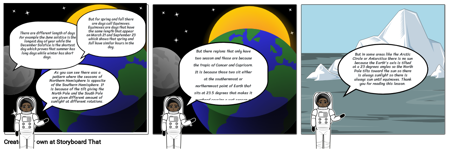
- But for spring and fall there are days call Equinoxes. Equinoxes are days that have the same length that appear on March 21 and September 23 which shows that spring and fall have similar hours in the day.
- There are different length of days for example the June solstice is the longest day of year while the December Solstice is the shortest day which proves that summer has long days while winter has short days.
- As you can see there was a pattern where the seasons of Northern Hemisphere is opposite of the Southern Hemisphere. It is because of the tilt giving the North Pole and the South Pole are given different amount of sunlight at different rotations.
- Deslizar: 2
- But there regions that only have two season and those are because the tropic of Cancer and Capricorn. It is because those two sit either at the southernmost or northernmost point of Earth that sits at 23.5 degrees that makes it overhead causing a wet season or dry season.
- Deslizar: 3
- But in some areas like the Arctic Circle or Antarctica there is no sun because the Earth's axis is tilted at a 23 degrees angles so the North Pole tilts toward the sun so there is always sunlight so there is always sun until equinoxes. Thank you for reading this lesson.