

Untitled Storyboard


Texto do Storyboard
- Deslizar: 1
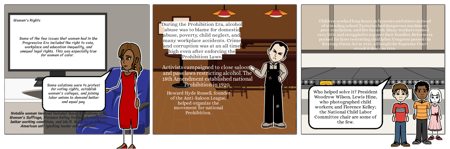
- Women's Rights
- Some of the few issues that women had in the Progressive Era included the right to vote, workplace and education inequality, and unequal legal rights. This was especially true for women of color.
- Some solutions were to protest for voting rights, establish women's colleges, and joining labor unions to demand better and equal pay.
- Notable women involved included Susan B. Anthony with Women's Suffrage, Florence Kelley for her advocacy with better working conditions, and Ida B. Wells as an African American anti lynching leader and journalist.
- Deslizar: 2
- During the Prohibition Era, alcohol abuse was to blame for domestic abuse, poverty, child neglect, and many workplace accidents. Crime and corruption was at an all time high even after enforcing the Prohibition Laws.
- Activists campaigned to close saloons and pass laws restricting alcohol. The 18th Amendment established national Prohibition in 1920.
-
- Howard Hyde Russell, founder of the Anti-Saloon League, helped organize the movement for national Prohibition.
- Deslizar: 3
- Children worked long hours in factories and mines instead of attending school. Factories had dangerous machinery, poor ventilation, and fire hazards. Many workers earned very little and struggled to support their families. Reformers pushed for laws restricting child labor. Congress passed the Keating-Owen Act in 1916, although the Supreme Court struck it down in 1918.
- Who helped solve it? President Woodrow Wilson, Lewis Hine, who photographed child workers; and Florence Kelley; the National Child Labor Committee chair are some of the few.