

 Înregistrează-te ca profesor

The increasingly popular rubric of ‘customer development’ encompasses the traditional disciplines of marketing, product management, and entrepreneurship. It re-segments and combines these disciplines into something entirely focused on new product/business creation. Its practice (and its originator, Steve Blank) has one overriding directive: get out into the world and understand the customer. Paired with design thinking , the discipline is highly useful in today’s dynamic, hyper competitive environment.
My work is about helping put this and other related techniques into practice. Crucial to your ultimate success is anchoring your understanding of the customer in a picture of how you think they experience life before and after they have your product - before and after, basically. For this, I love storyboarding.
Storyboarding Before and After Scenarios
I use a (fictional) example company called Enable Quiz in my book, Starting a Tech Business: A Practical Guide for Anyone Creating or Designing Applications or Software. They offer lightweight technical quizzes for anyone looking to assess the skill sets of engineers they’re looking to hire. The personas are Helen the HR Manager, Chris the Candidate, and Frank the Functional Manager. Helen’s responsible for doing initial interviews, Chris is being interviewed for the job, and Frank’s the hiring manager (Chris’ hypothetical future boss).
The panels below show a before and after for Enable Quiz’s customers:

Breaking Down Our Story
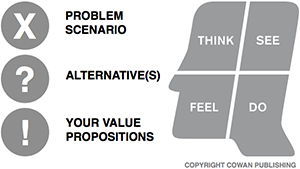
I like to start the customer discovery process with personas - vivid depictions of your customers in context (think-see-feel-do is a good checklist for describing them). These personas have problem scenarios - needs and desires they’d like to fulfill. They also have current alternatives - things they doing (or not doing) about the problem scenario today. You have a value proposition - something you’re going to offer that you hope is better enough than the current alternatives to win over the customer.
In our example, Helen the HR Manager’s top problem scenario is that it’s just about impossible for her to assess the technical abilities of candidates who come in for interviews. For Frank the Functional Manager, it’s possible, he has the expertise, but it’s time consuming and awkward. Right now, the alternatives for HR managers are to scan the resumes and maybe call references. For functional managers, it’s to go through an awkward, patchy assessment- or, equally likely, take it on a combination of faith and hope that the candidate has the necessary skills. The ‘Before’ board below describes this situation.
Before Enable Quiz
| Notes | Board |
|---|---|
|
Helen the HR Manager does an initial screening on Chris the Candidate. She can look at experience, but doesn’t really have the ability to validate the candidate’s skill set.
Chris the Candidate is then passed along to Frank the Functional Manager. |
 |
| Frank the Functional Manager is really busy and just goes and make the hire. |  |
|
But in this case a stitch in time would have saved nine - the candidate doesn't actually have the required skills to the degree Frank understood/expected/wanted.
Now Frank the Functional Manager has to figure out how to fix a situation where his employee doesn't have the right skill sets. |
 |
After Enable Quiz
The next board narrates the process once the personas of interest have access to the value propositions the Enable Quiz product offers.| Notes | Board |
|---|---|
| Helen the HR Manager now has a simple way to screen out candidates missing the skills Frank the Functional Manager has said are an absolute requirement. |  |
| Making good hires is rarely easy but Frank the Functional Manager now at least knows they’ll have a certain baseline skill set. |  |
| And life’s a lot better. |  |
Where? How?
All you need to storyboard is a surface and a writing implement. That said, getting started is daunting for some and I particularly like what they’ve done here at Storyboard That. Their tool’s approachable and easy to get going with since it’s web-based. The outputs are available in a few different formats. I usually grab the individual panels they output and put them in the type of table you see above.My advice is sit down and do a storyboard right now. A simple one will probably take you around 30 minutes. The first board above is actually embedded from the original on their site and you can use it as a starting point if you want.
Your Turn
What techniques have you used to better illustrate what you’ve supposed and what you’ve learned in your customer discovery? In particular, have you tried storyboards and how did they work for you? If you’re just trying them out, please let me know how it goes. Post a comment, respond to the related Tweet, drop me a line, post on LinkedIn- we’re in this together!About Alexander Cowan
Alex Cowan is the founder and CTO of Leonid Systems, a software company providing solutions to the world's largest communications providers. He has worked with companies ranging from start-ups to Fortune 100s, improving their competitive advantage in a fast-changing high-tech landscape. He lives in Aptos, California, and can be reached at www.alexandercowan.com, on Google Plus at Alexander Cowan.Cum să reprezentați scenarii problematice cu ajutorul storyboard-urilor
Crește implicarea elevilor cu ajutorul storyboard-urilor în clasă
Folosește storyboard-uri pentru a face lecțiile mai interactive și memorabile. Povestirea vizuală ajută elevii să-și organizeze gândurile și să lege ideile, făcând învățarea mai distractivă și mai eficientă pentru clasele 2–8.
Alege un subiect pentru storyboard
Alege un subiect sau un concept pe care elevii tăi îl studiază, cum ar fi un proces științific sau un eveniment istoric. Subiecte relevante fac activitățile de creare a storyboard-urilor mai semnificative și crește implicarea elevilor.
Împarte subiectul în scene sau pași cheie
Identifică 4–6 momente sau etape principale din lecție. Pași clari oferă elevilor un cadru simplu și ii ajută să se concentreze pe ceea ce este important.
Oferă elevilor șabloane pentru storyboard
Distribuie grile goale pentru benzi desenate sau folosește instrumente digitale precum Storyboard That. Șabloane structurate ghidează elevii și fac mai puțin intimidant desenatul și scrisul.
Încurajează elevii să ilustreze și să povestească fiecare scenă
Încurajează elevii să deseneze imagini și să adauge texte pentru fiecare moment cheie. Combinarea cuvintelor și imaginilor îmbunătățește înțelegerea și le permite gânditorilor creativi să strălucească.
Share and discuss storyboards as a class
Have students present their storyboards, then discuss different perspectives and key ideas. Collaborative sharing builds confidence and deepens understanding through peer feedback.
Întrebări frecvente despre reprezentarea scenariilor cu probleme cu ajutorul storyboard-urilor
Ce este storyboard-ul în descoperirea clienților și cum ajută educatorii?
Storyboard-ul în descoperirea clienților este o tehnică vizuală care mapează călătoria utilizatorului înainte și după utilizarea unui produs sau serviciu. Pentru educatori, ajută la clarificarea nevoilor elevilor, punctelor dureroase și rezultatelor, făcând planificarea lecțiilor și proiectarea curriculumului mai direcționate și eficiente.
Cum pot profesorii K-12 folosi storyboard-urile pentru a-și îmbunătăți planurile de lecții?
Profesorii K-12 pot utiliza storyboard-uri pentru a vizualiza scenarii din clasă, a anticipa provocările elevilor și a proiecta lecții care abordează direct aceste nevoi. Storyboard-urile fac conceptele abstracte mai concrete și ajută profesorii să creeze activități captivante și centrate pe elev.
Care este diferența dintre crearea de storyboard-uri și planificarea tradițională a lecțiilor?
Storyboard-urile se concentrează pe maparea experienței pas cu pas a elevilor, în timp ce planificarea tradițională listează adesea activități și obiective. Storyboard-urile adaugă un element vizual și narativ care ajută profesorii să observe lacunele și oportunitățile în înțelegerea elevilor.
De ce este utilă vizualizarea scenariilor 'înainte și după' pentru profesori?
Vizualizarea 'înainte și după' permite profesorilor să vadă impactul lecțiilor asupra abilităților și comportamentelor elevilor. Evidențiază zonele ce necesită îmbunătățiri și ajută educatorii să adapteze predarea pentru a maximiza rezultatele învățării.
Care sunt pașii pentru a începe crearea de storyboard-uri pentru o activitate în clasă?
Pentru a începe crearea de storyboard-uri pentru o activitate în clasă: 1) Identificați obiectivul de învățare, 2) Creați personaje pentru elevii dvs., 3) Maparea experienței lor înainte de lecție, 4) Planificați pașii în timpul activității și 5) Vizualizați rezultatele dorite după lecție.
© 2026 - Clever Prototypes, LLC - Toate drepturile rezervate.
StoryboardThat este o marcă comercială a Clever Prototypes , LLC și înregistrată la Oficiul de brevete și mărci comerciale din SUA