

COMICS-1


Storyboard Text
- Slide: 1
- Dots and Decisions:
- Understanding Scatter Plots and Pearson’s r
- Slide: 2
- CHARACTERS:➜ Ms. Reyes – Their statistics teacher➜ Ken – Analytical friend, good with numbers➜ Mia – Curious student, asks lots of questions
- Slide: 3
- Ken, what are these dots supposed to mean?
- Slide: 6
- It looks kind of like a straight line!
- So the form is linear.
- Slide: 8
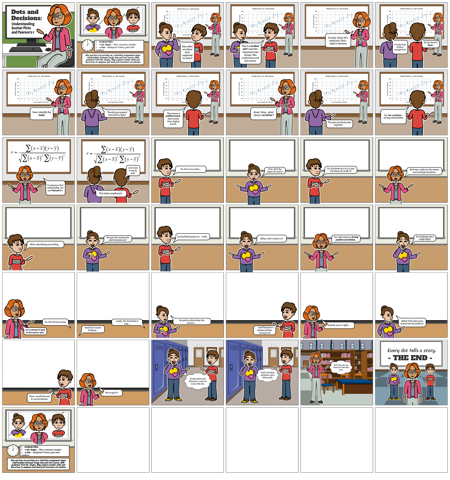
- Mia and Ken are working on a statistics assignment about relationships between study time and test scores. With guidance from Ms. Reyes, they explore scatter plots and learn how to compute and interpret Pearson’s correlation coefficient.
- The dots go upward from left to right!
- Slide: 11
- The dots are kinda close together…
- Slide: 13
-
- To measure that relationship, we use Pearson’s r.
- Slide: 14
- That looks complicated...
- Slide: 27
- So scatter plots show the pattern…
- Slide: 29
- Exactly, you're right...
- Slide: 30
- What if the dots were scattered everywhere?
- Slide: 31
- Let’s connect it back to the scatter plot.
- Slide: 32
- You’ve got it!
- Slide: 36
- Every dot tells a story.
- - THE END -
- Slide: 37
- CHARACTERS:➜ Ms. Reyes – Their statistics teacher➜ Ken – Analytical friend, good with numbers➜ Mia – Curious student, asks lots of questions
- Mia and Ken are working on a statistics assignment about relationships between study time and test scores. With guidance from Ms. Reyes, they explore scatter plots and learn how to compute and interpret Pearson’s correlation coefficient.
- Slide: 0
- That’s a scatter plot. Each dot represents two values—like study hours and test scores.
- Exactly. Now, let’s analyze it. First—what’s the form
- Good. Now, what about variation?
- That means a positive trend—more study time, higher scores.
- Next, identify the trend.
- So, low variation—strong relationship.
- Let’s break it step by step!
- So, here's our data...
- First, find the mean of x and y!
- So, the Mean of x is 2.5, and the Mean of y is 68.75
- And now, subtract the means and multiply deviation
- After calculating everything…
- We got the numerator and denominator!
- So the final answer is r ≈ 0.98..
- Whoa, that’s close to 1!
- Yes, that means a strong positive correlation..
- So studying more really helps!
- And the Trend is Positive...
- Lastly, the Variation is Low...
- So, the Form is Linear
- …and Pearson’s r measures how strong it is!
- Then r would be near 0—no correlation.
- Scatter plots and Pearson’s r aren’t so scary after all...
- Yeah—just dots, patterns, and a little math.
- And now you can interpret data like pros.