

 Зарегистрируйтесь как учитель.
Untitled Storyboard


Текст Раскадровки
- Горка: 1
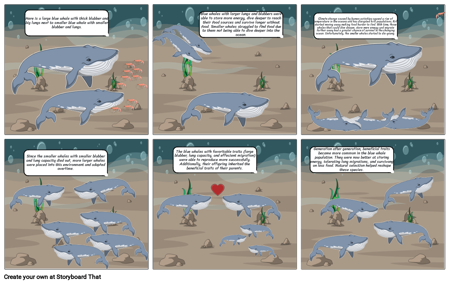
- Here is a large blue whale with thick blubber and big lungs next to smaller blue whale with smaller blubber and lungs.
- Горка: 2
- Blue whales with larger lungs and blubbers were able to store more energy, dive deeper to reach their food sources and survive longer without food. Smaller whales struggled to find food due to them not being able to dive deeper into the ocean.
- Горка: 3
- Climate change caused by human activities caused a rise of temperature in the oceans and has disrupted krill populations. Krill started moving away making food harder to find. With time, those whales that could dive deeper, store more energy and migrate farther away had a greater chance of survival in the changing ocean. Unfortunately, the smaller whales started to die young.
- Горка: 4
- Since the smaller whales with smaller blubber and lung capacity died out, more larger whales were placed into this environment and adapted overtime.
- Горка: 5
- The blue whales with favoritable traits (large blubber, lung capacity, and effecient migration) were able to reproduce more successfully. Additionally, their offspring inherited the beneficial traits of their parents.
- Горка: 6
- Generation after generation, beneficial traits became more common in the blue whale population. They were now better at storing energy, tolerating long migrations, and survivong on less food. Natural selection helped reshape these species.
Создано более 40 миллионов раскадровок.
Никаких Загрузок, Кредитной Карты и Входа в Систему не Требуется!
