

Untitled Storyboard


Text z Príbehu
- Šmykľavka: 1
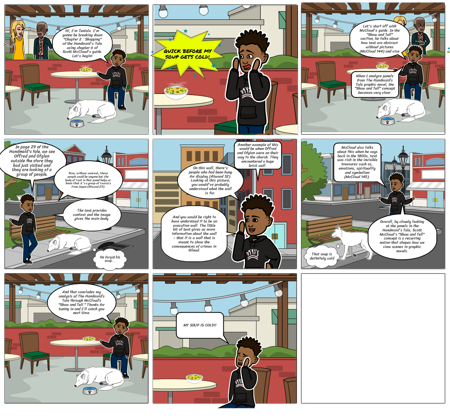
- Hi, I'm Teniola. I'm gonna be breaking down "Chapter 2 : Shopping" of the Handmaid's Tale using chapter 6 of Scott McCloud's guide. Let's begin!
- Šmykľavka: 2
-
- QUICK BEFORE MY SOUP GETS COLD!
- Šmykľavka: 3
- Let's start off with McCloud's guide. In the "Show and Tell" section, he talks about how text are abstract without pictures (McCloud 144) and vice versa.
- When I analyze panels from The Handmaid’s Tale graphic novel, the "Show and Tell" concept becomes very clear.
- Šmykľavka: 4
- In page 29 of the Handmaid's tale, we see Offred and Ofglen outside the store they had just visited and they are looking at a group of people.
- Now, without context, these people could be anyone but the body of text in that panel helps us know that it's a group of tourists from Japan (Atwood 29).
- The text provides context and the image gives the main body.
- He forgot his soup...
- Šmykľavka: 5
- Another example of this would be when Offred and Ofglen were on their way to the church. They encountered a huge brick wall.
- On this wall, there's people who had been hung for display (Atwood 32). Looking at this picture, you would've probably understood what the wall is for.
- Šmykľavka: 6
- McCloud also talks about this when he says back in the 1800s, text was rich in the invisible treasures such as, emotions, spirituality and symbolism (McCloud 145).
- Šmykľavka: 7
- And that concludes my analysis of The Handmaid’s Tale through McCloud’s "Show and Tell." Thanks for tuning in and I'll catch you next time.
- Šmykľavka: 8
- MY SOUP IS COLD!!
- Šmykľavka: 0
-
- And you would be right to have understood it to be an execution wall. The little bit of text gives us more information about the wall - that it is a wall that is meant to show the consequences of crimes in Gilead.
- That soup is definitely cold
- Overall, by closely looking at the panels in the Handmaid's Tale, Scott McCloud's "Show and Tell" concept is a recurring notion that shapes how we view scenes in graphic novels.