

 Zaregistrovať sa ako učiteľ
Aaron Douglas's life. By Ashan James


Text z Príbehu
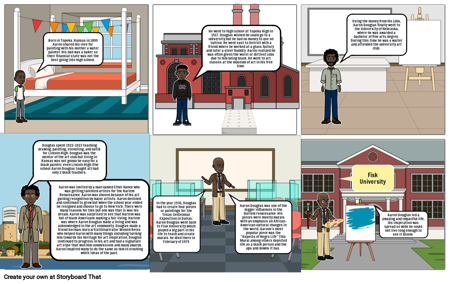
- Born in Topeka, Kansas in 1899 Aaron shared his love for painting with his mother a water painter. His dad was a baker so their financial state was not the best going into high school.
- He went to high school at Topeka High in 1917. Douglas wished he could go to a university but he had no money to use on tuition. He went east to Detroit with a friend where he worked at a glass factory and later a steel foundry. Aaron realized he was often given the worst or dirtiest jobs due to him being black. He went to art classes at the museum of art in his free time.
- Using the money from his jobs, Aaron Douglas finally went to the University of Nebraska, where he was awarded a bachelor of fine arts degree. During this time he was a waiter and attended the university art club.
- Douglas spent 1922-1923 teaching drawing, painting, stenciling, and batik for Lincoln High. Douglas was the mentor of the art club but living in Kansas was not gonna be easy for a black painter, even Lincoln High (the school Aaron Douglas taught at) had only 2 black teachers.
- Aaron was invited by a man named Ethel Nance who was getting talented artists for the Harlem Renaissance. Aaron was chosen because of his art gaining recognition by major artists. Aaron declined and continued to grow but when the school year ended he resigned and choose to go to New York. There were many reasons for this but one was that is was his dream. Aaron was surprised to see that Harlem was full of black Americans making a fair living. Harlem was where Aaron Douglas made a living and was acknowledged in the art community. Douglas made a friend German-born artist/illustrator Winold Reiss who helped Aaron with many things including turning him towards his heritage for art inspiration. Douglas continued to progress in his art and had a signature art style that won him commissions and many awards. Aaron inspired many to do the same as him in crushing white ideas of the past.
- In the year 1936, Douglas had to create four pieces or paintings for the Texas Centennial Exposition in Dallas. Aaron Douglas went back to Fisk University which played a big part in his life to teach and create murals. he died there in February of 1979
- Aaron Douglas was one of the bigger influences in the Harlem renaissance. His pieces were mostly murals with an emphasis on African-American cultural changes in the world. Aarons's most popular piece was the “Aspects of Negro Life” This Mural among others depicted life as a black person and the ups and downs it has.
- Fisk University
-
-
- Aaron Douglas led a amazing and impactful life, his inspiration was spread so wide he could not live long enough to see it bloom.
Vytvorených viac ako 40 miliónov storyboardov
Na Vyskúšanie nie je Potrebné Žiadne Sťahovanie, Žiadna Kreditná Karta a Žiadne Prihlásenie!
