

 Registrera dig som lärare
Unknown Story


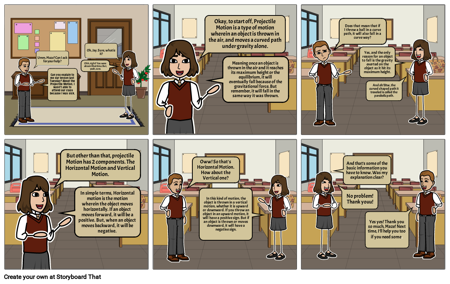
Storyboard Text
- Umm, Maze? Can I ask for your help?
- Can you explain to me our lesson last Tuesday? About the Projectile Motion. I wasn't able to attend our class because I was sick.
- Ohh, right! You were absent that time. But, yeah, sure.
- Oh, Jay. Sure, what is it?
- Okay, to start off, Projectile Motion is a type of motion wherein an object is thrown in the air, and moves a curved path under gravity alone.
- Meaning once an object is thrown in the air and it reaches its maximum height or the equilibrium, it will eventually fall because of the gravitational force. But remember, it will fall in the same way it was thrown.
- Does that mean that if I throw a ball in a curve path, it will also fall in a curve way?
- And oh! Btw, the curved shaped path it traveled is called the parabolic path.
- Okay, to start off, Projectile Motion is a type of motion wherein an object is thrown in the air, and moves a curved path under gravity alone. 
- Yes, and the only reason for an object to fall is the gravity exerted on the object as it hit its maximum height.
- But other than that, projectile Motion has 2 components. The Horizontal Motion and Vertical Motion.
- In simple terms, Horizontal motion is the motion wherein the object moves horizontally. If an object moves forward, it will be a positive. But, when an object moves backward, it will be negative.
- Oww! So that's Horizontal Motion. How about the Vertical one?
- In this kind of motion, the object is thrown in a vertical motion, whether it is upward or downward. If you throw an object in an upward motion, it will have a positive sign. But if an object is thrown or moves downward, it will have a negative sign.
- And that's some of the basic information you have to know. Was my explanation clear?
- Yes yes! Thank you so much, Maze! Next time, I'll help you too if you need some.
- No problem! Thank youu!
Över 40 miljoner storyboards skapade
Inga Nedladdningar, Inget Kreditkort och Ingen Inloggning Behövs för att Prova!
