

Untitled Storyboard


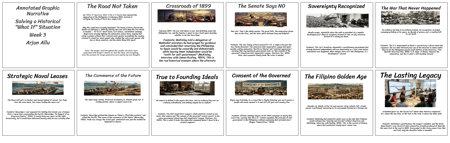
Storyboard Text
- Glida: 1
- Annotated Graphic NarrativeSolving a Historical "What If" SituationWeek 3Arjun Allu
- Glida: 2
- The Road Not Taken
- My "What if" Question: What if the U.S Senate had rejected the annexation of the Philippines in February 1899, instead of ratifying the Treaty of Paris by a single vote?
- Why this could have actually happened: The Treaty of Paris cleared the Senate on February 6, 1899 by exactly one vote more than the two-thirds it needed — 57 to 27. Mark Twain, Carl Schurz, and William Jennings Bryan were already fighting the annexation clause hard, arguing that ruling a people without their consent went against everything the country claimed to stand for. Most people who studied the vote count agreed: flip two or three senators, and the whole thing falls apart.
- Note: The images used throughout this graphic narrative were generated with Google's Gemini AI. But the ideas and everything, even the prompts for image generation were purely my own thoughts.
- Glida: 3
- Crossroads of 1899
- February 1899. The war with Spain is over, but McKinley wants the Philippines too, and the Senate is about to tear itself apart deciding whether to let him have them.
- Footnote: McKinley told a delegation of Methodist ministers he had prayed for guidance and concluded that returning the Philippines to Spain would be cowardly and dishonorable, while leaving them independent would be "unfit for self-government" (McKinley, interview with James Rusling, 1899). This is the real historical moment where the alternate timeline begins.
- Glida: 4
- The Senate Says NO
- One vote. That's the whole margin. The gavel falls, the annexation clause dies on the floor, and the room splits between fury and disbelief.
- Footnote: The real Treaty of Paris passed 57–27, a single vote past the two-thirds threshold. The American Anti-Imperialist League had spent months calling annexation "hostile to liberty" and "criminal aggression," insisting that any legitimate government rests on "the consent of the governed" (American Anti-Imperialist League, Platform, Oct. 1899). Here, that argument finally lands the votes it needed.
- Glida: 5
- Sovereignty Recognized
- Manila erupts. Aguinaldo takes the oath as president of a republic Washington just chose to recognize instead of rule; an ally raised up instead of a colony put down.
- Footnote: This isn't invention; Aguinaldo's revolutionary government had already declared independence and was functioning as a real state before annexation ever happened. What changes here isn't the Philippines; it's Washington's answer.
- Glida: 6
- The War That Never Happened
- An ordinary morning in an ordinary market. No occupation, no jungle campaign grinding on for years, no decade of graves; just a country left to run itself.
- Footnote: The U.S. Department of State's own history is direct about the sequence: the war that followed grew out of the decision to annex rather than to let the Philippines govern itself (Office of the Historian, "The Spanish-American War, 1898," U.S. Dept. of State). Remove the annexation, and this is what's left standing instead.
- Glida: 7
- Strategic Naval Leases
- The Navy still gets its harbor; just leased instead of seized. Two flags over the same dock, two crews loading the same coal.
- Footnote: Beveridge's real argument for holding the islands was strategic first; a naval base commanding the Pacific (Beveridge, "In Support of an American Empire," 1900). A treaty lease was never on the table historically, but it would have delivered exactly what he was actually after.
- Glida: 8
- The Commerce of the Future
- The ships keep coming. American machinery in, Filipino goods out. A trading partner where a subject used to be.
- Footnote: Beveridge pitched the Senate on "China's illimitable markets" and called the Pacific "the ocean of the commerce of the future" (Beveridge, 1900). Trade was always the actual goal; annexation was just the method he happened to choose.
- Glida: 9
- True to Founding Ideals
- No empire to defend in the papers this time. Just an ordinary flag over an ordinary schoolhouse, and nothing anyone has to explain.
- Footnote: The Anti-Imperialist League's whole platform rested on one claim: that empire and "the consent of the governed" cannot coexist in the same government (American Anti-Imperialist League, Platform, Oct. 1899). This is what it looks like when that argument doesn't have to be a protest anymore.
- Glida: 10
- Consent of the Governed
- Bryan says it plainly, to a crowd that's finally listening: you can't govern a people who never agreed to it and still call your own country free.
- Footnote: William Jennings Bryan ran his 1900 campaign on nearly this exact line, warning that the U.S. "cannot repudiate the principle of self-government in the Philippines without weakening that principle here" (Bryan, "Imperialism," 1900).
- Glida: 11
- The Filipino Golden Age
- Decades on, Manila writes its own success story; schools full, streets paved, a parliament answering to its own people instead of a foreign one.
- Footnote: McKinley had staked his whole case on the idea that Filipinos would collapse into "anarchy and misrule" without American rule (McKinley, interview with Rusling, 1899). This is the version of history where that prediction simply never comes true.
- Glida: 12
- The Lasting Legacy
- A hundred years on, the lesson isn't about what America conquered. It's about the one time, at the fork in the road, it chose the other path.
- Footnote: McKinley's justification, the League's rebuttal, and the State Department's own record of what annexation actually produced all describe the same fork in the road in 1899. Every panel in this story comes from that real fork; only the direction taken is invented.