

Untitled Storyboard


Storyboard Text
- Glida: 1
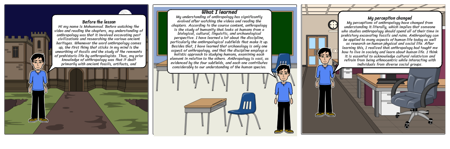
- Before the lessonHi my name is Mohammad. Before watching the video and reading the chapters, my understanding of anthropology was that it involved excavating past civilizations and researching the various ancient heritages. Whenever the word anthropology comes up, the first thing that sticks in my mind is the unearthing of fossils and the study of the remnants of prehistoric life by anthropologists. Thus, my prior knowledge of anthropology was that it dealt primarily with ancient fossils, artifacts, and excavations.
- Glida: 2
- What I learnedMy understanding of anthropology has significantly evolved after watching the videos and reading the chapters. According to the course content, anthropology is the study of humanity that looks at humans from a biological, cultural, linguistic, and archaeological perspective. I have learned a lot about the discipline, particularly the anthropological subfields that make it up. Besides that, I have learned that archaeology is only one aspect of anthropology, and that the discipline employs a holistic approach to studying humans, examining each element in relation to the others. Anthropology is vast, as evidenced by the four subfields, and each one contributes considerably to our understanding of the human species.
- Glida: 3
- My perception changedMy perceptions of anthropology have changed from understanding it literally, which implies that someone who studies anthropology should spend all of their time in prehistory excavating fossils and ruins. Anthropology can be applied to many aspects of human life today as well as research on human physical and social life. After learning this, I realized that anthropology had taught me how to live in society and learn about human life. I think it is essential to acknowledge cultural relativism and refrain from being ethnocentric while interacting with individuals from diverse social groups.