

 سجل كمعلم
The Tragedy of Julius Caesar Storyboard


نص القصة المصورة
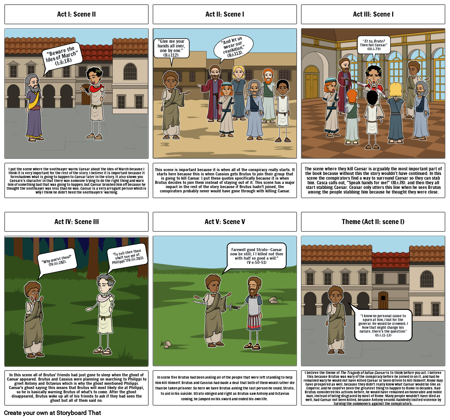
- Act I: Scene II
- "Beware the Ides of March" (I:ii:18)
- Act II: Scene I
- "Give me your hands all over, one by one." (II:i:112).
- "And let us swear our resolution." (II:i:113).
- Act III: Scene I
- "Et tu, Brute?  Then fall Caesar." (III:i:79)
- I put the scene where the soothsayer warns Caesar about the Ides of March because I think it is very important for the rest of the story. I believe it is important because it foreshadows what is going to happen to Caesar later in the story. It also shows you Caesars's character in that there was someone trying to do the right thing and warn him of something bad that was going to happen, but Caesar brushed him off because he thought the soothsayer was less than he was. Caesar is a very arrogant person which is why I think he didn't heed the soothsayers' warning.
- Act IV: Scene III
- "Why com'st thou?" (IV:iii:282).
- "To tell thee thou shalt see me at Philippi."(IV:iii:283).
- This scene is important because it is when all of the conspiracy really starts. It starts here because this is when Cassius gets Brutus to join their group that is going to kill Caesar. I put these quotes specifically because it is when Brutus decides to join them instead of staying out of it. This scene has a major impact in the rest of the story because if Brutus hadn't joined, the conspirators probably never would have gone through with killing Caesar.
- Act V: Scene V
- Farewell good Strato--Caesar now be still; / I killed not thee with half so good a will." (V:v:50-51)
- The scene where they kill Caesar is arguably the most important part of the book because without this the story wouldn't have continued. In this scene the conspirators find a way to surround Caesar so they can stab him. Casca calls out, "Speak hands for me!" (III:i:78). and then they all start stabbing Caesar. Ceasar only utters this line when he sees Brutus among the people stabbing him because he thought they were close.
- Theme (Act II: scene I)
- In this scene all of Brutus' friends had just gone to sleep when the ghost of Caesar appeared. Brutus and Cassius were planning on marching to Philippi to greet Antony and Octavius which is why the ghost mentioned Philippi. Caesar's ghost saying this means that Brutus will most likely die at Philippi, so he is basically warning Brutus of what's to come. After the ghost disappeared, Brutus woke up all of his friends to ask if they had seen the ghost but all of them said no.
- In scene five Brutus had been asking all of the people that were left standing to help him kill himself. Brutus and Cassius had made a deal that both of them would rather die than be taken prisoner. So here we have Brutus asking the last person he could, Strato, to aid in his suicide. Strato obliged and right as Brutus saw Antony and Octavius coming, he jumped on his sword and ended his own life. 
- I believe the theme of The Tragedy of Julius Caesar is to think before you act. I believe this because Brutus was wary of the conspiracy before he joined in on it, and had he remained wary he would not have killed Caesar or been driven to kill himself. Rome may have prospered as well, because they didn't really know what Caesar would be like as Emperor, and he could've been the greatest thing to happen to Rome in decades. Had Brutus considered his actions before, he would have remained an honorable and noble man, instead of being disgraced by most of Rome. Many people wouldn't have died as well, had Caesar not been killed, because Antony second-handedly incited violence by turning the commoners against the conspirators.
- "I know no personal cause to spurn at him, / but for the general. He would be crowned. / Now that might change his nature, there's the question." (II:i:11-13)
تم إنشاء أكثر من 40 مليون لوحة قصصية
لا توجد تنزيلات ولا بطاقة ائتمان ولا حاجة إلى تسجيل الدخول للمحاولة!
