

Unknown Story


نص القصة المصورة
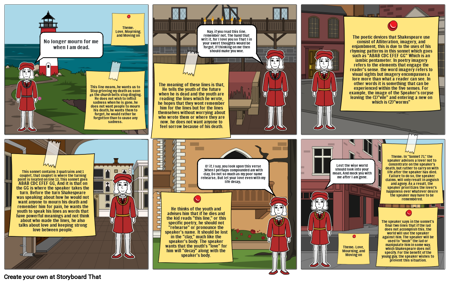
- No longer mourn for me when I am dead.
- This line means, he wants us to Stop grieving my death as soon as the church bells stop dinging. He does not wish to inflict sadness when he is gone, he does not want people to mourn his death, he wants them to forget, he would rather be forgotten than to cause any sadness.
- Theme:Love, Mourning, and Moving on
- The meaning of these lines is that, He tells the youth of the future when he is dead and the youth are reading the lines which he wrote, he hopes that they wont remember him for the lines but for the lines themselves without worrying about who wrote them or where they are now. he does not want anyone to feel sorrow because of his death.
- Nay, if you read this line, remember not, The hand that writ it, for I love you so That I in your sweet thoughts would be forgot, If thinking on me then should make you woe.
- The poetic devices that Shakespeare use consist of Alliteration, imagery, and enjambment, this is due to the uses of his rhyming patterns in this sonnet which goes such as "ABAB CDC EFEF GG" Which is an iambic pentameter. In poetry imagery refers to the elements that engage the reader's sense. the word imagery refers to visual sights but imagery encompasses a lore more than what a reader can see. In other words it is something that can be experienced within the five senses. For example, the image of the Speaker's corpse leaving the (1)"vile" and entering a new on which is (2)"worms"
- Theme: In "Sonnet 71," the speaker advises a lover not to concentrate on the speaker's death, but rather to carry on with life after the speaker has died. Failure to do so, the speaker claims, will only result in anguish and agony. As a result, the speaker prioritizes the lover's happiness over whatever desire the speaker may have to be remembered.
- This sonnet contains 3 quatrains and 1 couplet, that couplet is where the turning point is located on line 13, This sonnet goes ABAB CDC EFEF GG, And it is that on the GG is where the speaker takes the turn. Before the turn Shakespeare was speaking about how he would not want anyone to mourn his death and remember him for pain, he wants the youth to speak his lines as words that have powerful meanings and not think about who made the lines, he also talks about love and keeping strong love between people.
- He thinks of the youth and advises him that if he dies and the kid reads "this line," or this specific poetry, he should not "rehearse" or pronounce the speaker's name. It should be lost in the "clay," much like the speaker's body. The speaker wants that the youth's "love" for him will "decay" along with the speaker's body.
- O! if, I say, you look upon this verse ,When I perhaps compounded am with clay, Do not so much as my poor name rehearse; But let your love even with my life decay;
- Lest the wise world should look into your moan, And mock you with me after I am gone.
- Theme: Love, Mourning, and Moving on
- The speaker says in the sonnet's final two lines that if the lad does not accomplish this, the world will use the speaker against him. The speaker will be used to "mock" the lad or manipulate him in some way, which Shakespeare does not specify. For the benefit of the young guy, the speaker wishes to prevent this situation.