

 Registrer dig som lærer
James Benton; Julius Caesar


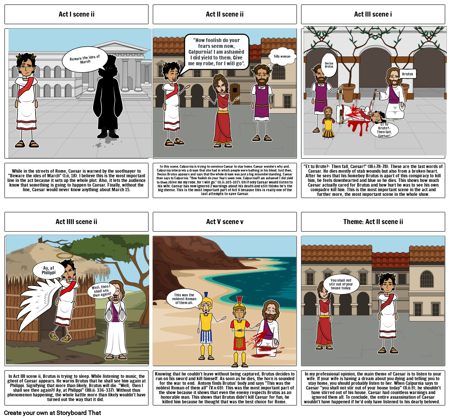
Storyboard Beskrivelse
Probably the best storyboard that Mrs Ginder & Ms. Jones will ever read.
Storyboard Tekst
- Act I scene ii
- Beware the ides of March
- Act II scene ii
- "How foolish do your fears seem now, Calpurnia! I am ashamèd I did yield to them. Give me my robe, for I will go".
- Silly woman
- Act III scene i
- Decius Brutus
- Et tu Brute?-Then fall, Caesar!
- Brutus
- While in the streets of Rome, Caesar is warned by the soothsayer to "Beware the ides of March" (I:ii; 18). I believe this is the most important line in the act because it sets up the whole plot. Also, it lets the audience know that something is going to happen to Caesar. Finally, without the line, Caesar would never know anything about March 15.
- Act IIII scene ii
- Ay, at Philippi
- In this scene, Calpurnia is trying to convince Caesar to stay home. Caesar wonders why and, Calpurnia interprets a dream that she had in which people were bathing in his blood. Just then,  Decius Brutus appears and says that the whole dream was just a big misunderstanding. Caesar then says to Calpurnia  "How foolish do your fears seem now, Calpurnia!/I am ashamed I did yield to them./Give me my robe, for I will go." (II:ii:105-107). Oh if only Caesar would listen to his wife. Caesar has now ignored 2 warnings about his death and still thinks he's the big cheese. This is the most important part of Act II because this is really one of the last attempts to save Caesar.
- Act V scene v
- "Et tu Brute?- Then fall, Caesar!" (III:i:78-78). These are the last words of Caesar. He dies mostly of stab wounds but also from a broken heart. After he sees that his homeboy Brutus is apart of this conspiracy to kill him, he feels downhearted and blue so he dies. This shows how much Caesar actually cared for Brutus and how hurt he was to see his own compadre kill him. This is the most important scene in the act and further more, the most important scene in the whole show.
- Theme: Act II scene ii
- In Act IIII scene ii, Brutus is trying to sleep. While listening to music, the ghost of Caesar appears. He warns Brutus that he shall see him again at Philippi. Signifying that more than likely, Brutus will die. "Well;  then I shall see thee again?/ Ay, at Philippi" (IIII:ii: 336-337). Without thus phenomenon happening, the whole battle more than likely wouldn't have turned out the way that it did.  
- Well; then I shall see thee again?
- Knowing that he couldn't leave without being captured, Brutus decides to run on his sword and kill himself. As soon as he dies, the horn is sounded for the war to end.  Antony finds Brutus' body and says "This was the noblest Roman of them all" (V:v:69). This was the most important part of the show because it shows that even the enemy respects Brutus as an honorable man. This shows that Brutus didn't kill Caesar for fun, he killed him because he thought that was the best choice for Rome. 
- This was the noblest Roman of them all.
- In my professional opinion, the main theme of Caesar is to listen to your wife. If your wife is having a dream about you dying and telling you to stay home, you should probably listen to her. When Calpurnia says to Caesar "you shall not stir out of your house today" (II:ii:9), he shouldn't have stirred out of his house. Caesar had countless warnings and ignored them all. To conclude, the entire assassination of Caesar wouldn't have happened if he'd only have listened to his dearly beloved.  
- You shall not stir out of your house today.
Over 40 millioner storyboards skabt
Ingen Downloads, Intet Kreditkort og Intet Login Nødvendigt for at Prøve!
