

results


Storyboard Tekst
- Glide: 1
- Results
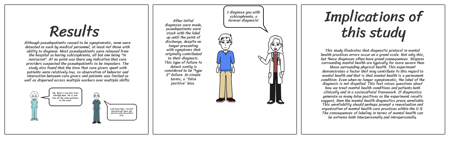
- Although pseudopatients ceased to be symptomatic, none were detected as such by medical personnel, at least not those with ability to diagnose. Most pseudopatients were released from the hospital as having schizophrenia, all but one being "in remission". At no point was there any indication that care providers suspected the pseudopatients to be imposters. The study also found that the time that care givers spent with patients were relatively low, so observation of behavior and interaction between care givers and patients was limited as well as dispersed across multiple workers over multiple shifts.
- Oh, Tyler? I see him 9am through 6pm. He is just like all the other patients in the ward.
- I also know Tyler. I see him 6pm through 12am. Not much to note about that guy.
- Glide: 2
- I diagnose you withschizophrenia, a forever diagnosis!
- After initial diagnoses were made, psuedopatients were stuck with the label up until the point of discharge, despite no longer presenting with symptoms that originally contributed to their diagnosis. This type of failure to detect sanity is considered to be "type 2" failure. In simple terms, a 'false positive' bias.
- Glide: 3
- Implications of this study
- This study illustrates that diagnostic protocol in mental health practices errors occur on a grand scale. Not only this, but these diagnoses often have grand consequences. Stigmas surrounding mental health are typically far more severe than those surrounding physical health. This experiment demonstrates a factor that may contribute to this regard to mental health and that is that mental health is a permanent condition. Even when no longer symptomatic, the label of the diagnosis is not dispelled. This test raises questions about how we treat mental health conditions and patients both clinically and in a sociocultural framework. If diagnostics generate as many false positives as the experiment results suggest, then the mental health diagnostics prove unreliable. This unreliability should perhaps prompt a reevaluation and organization of mental health care practices within the U.S. The consequences of labeling in terms of mental health can be extreme both interpersonally and intrapersonally.