

Unknown Story


Storyboard-Text
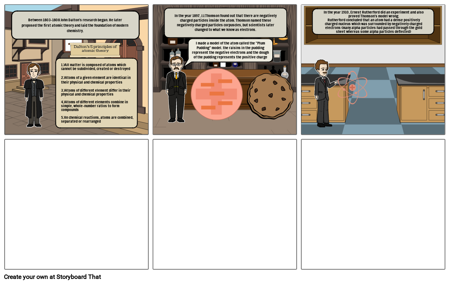
- Between 1803-1808 John Dalton's research began. He later proposed the first atomic theory and laid the foundation of modern chemistry.
- 1.)All matter is composed of atoms which cannot be subdivided, created or destroyed2.)Atoms of a given element are identical in their physical and chemical properties3.)Atoms of different element differ in their physical and chemical properties4.)Atoms of different elements combine in simple, whole-number ratios to form compounds5.)In chemical reactions, atoms are combined, separated or rearranged
- Dalton's 5 principles of atomic theory
- In the year 1897, J.J.Thomson found out that there are negatively charged particles inside the atom. Thomson named these negatively charged particles corpuscles, but scientists later changed to what we know as electrons.
- I made a model of the atom called the "Plum Pudding" model. the raisins in the pudding represent the negative electrons and the dough of the pudding represents the positive charge
- In the year 1910, Ernest Rutherford did an experiment and also proved Thomson's model wrong.Rutherford concluded that an atom had a dense positively charged nucleus which was surrounded by negatively charged electrons (many alpha particles had passed through the gold sheet whereas some alpha particles deflected)