

Moon Patterns Tour Guide


Texto del Guión Gráfico
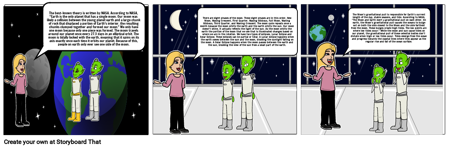
- The best-known theory is written by NASA. According to NASA, “Earth is the only planet that has a single moon. Our moon was likely a collision between the young planet earth and a large chunk of rock that displaced a portion of Earth's interior. the resulting chunks clumped together and formed our moon.” We only have one moon because only one piece was formed. The moon travels around our planet once every 27.3 days in an elliptical orbit. The moon is tidally locked with the earth, meaning that it spins on its axis exactly once each time it orbits our planet. Because of this, people on earth only ever see one side of the moon.
- There are eight phases of the moon. These eight phases are in this order, New Moon, Waxing Crescent, First Quarter, Waxing Gibbous, Full Moon, Waning Gibbous, Third Quarter, and Waning Crescent. The moon cycle repeats once a month because the moon orbits the earth and the earth orbits the sun. Our moon doesn't shine, it actually reflects the light of the sun. As the moon orbits the earth the portion of the moon that we see that is illuminated changes based on where we are in the rotation. We have two types of eclipses, Lunar Eclipse and Solar Eclipse. These eclipses can be partial or total. A Lunar eclipse happens when the earth comes between the sun and the moon, blocking the sunlight falling on the moon. A Solar Eclipse happens when the moon passes between the earth and the sun, blocking the view of the sun from a small part of the earth.
- The Moon’s gravitational pull is responsible for Earth’s current length of the day, stable seasons, and tide. According to NASA, “The Moon and Earth exert a gravitational pull on each other. On earth, the Moon’s gravitational pull causes the oceans to bulge out on both the side closest to the Moon and the side farthest from the moon. These bulges create high tides. The low points are where low tides occur.” While the moon and sun cause tides on our planet, the gravitational pull of these celestial bodies don't dictate when high or low tides occur. Tides emerge from the ocean and progress towards the coastal lines where they appear as the regular rise and fall of the ocean surface.