

History of computers part 2


Texto del Guión Gráfico
- Deslizar: 1
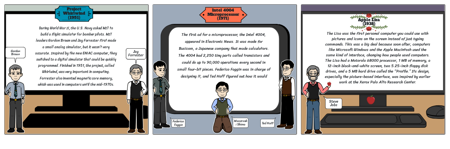
- Project Whirlwind (1951)
- During World War II, the U.S. Navy asked MIT to build a flight simulator for bomber pilots. MIT leaders Gordon Brown and Jay Forrester first made a small analog simulator, but it wasn’t very accurate. Inspired by the new ENIAC computer, they switched to a digital simulator that could be quickly programmed. Finished in 1951, the project, called Whirlwind, was very important in computing. Forrester also invented magnetic core memory, which was used in computers until the mid-1970s.
- Gordon Brown
- Jay Forrester
- Deslizar: 2
- Intel 4004 Microprocessor (1971)
- The first ad for a microprocessor, the Intel 4004, appeared in Electronic News. It was made for Busicom, a Japanese company that made calculators. The 4004 had 2,250 tiny parts called transistors and could do up to 90,000 operations every second in small four-bit pieces. Federico Faggin was in charge of designing it, and Ted Hoff figured out how it would work.
- Masatoshi Shima
- Federico Faggin
- Deslizar: 3
- Apple Lisa (1938)
- The Lisa was the first personal computer you could use with pictures and icons on the screen instead of just typing commands. This was a big deal because soon after, computers like Microsoft Windows and the Apple Macintosh used the same kind of interface, changing how people used computers. The Lisa had a Motorola 68000 processor, 1 MB of memory, a 12-inch black-and-white screen, two 5.25-inch floppy disk drives, and a 5 MB hard drive called the “Profile.” Its design, especially the picture-based interface, was inspired by earlier work at the Xerox Palo Alto Research Center.
- Steve Jobs
- Deslizar: 0
- Ted Hoff