

 Registreeru õpetajaks

The increasingly popular rubric of ‘customer development’ encompasses the traditional disciplines of marketing, product management, and entrepreneurship. It re-segments and combines these disciplines into something entirely focused on new product/business creation. Its practice (and its originator, Steve Blank) has one overriding directive: get out into the world and understand the customer. Paired with design thinking , the discipline is highly useful in today’s dynamic, hyper competitive environment.
My work is about helping put this and other related techniques into practice. Crucial to your ultimate success is anchoring your understanding of the customer in a picture of how you think they experience life before and after they have your product - before and after, basically. For this, I love storyboarding.
Storyboarding Before and After Scenarios
I use a (fictional) example company called Enable Quiz in my book, Starting a Tech Business: A Practical Guide for Anyone Creating or Designing Applications or Software. They offer lightweight technical quizzes for anyone looking to assess the skill sets of engineers they’re looking to hire. The personas are Helen the HR Manager, Chris the Candidate, and Frank the Functional Manager. Helen’s responsible for doing initial interviews, Chris is being interviewed for the job, and Frank’s the hiring manager (Chris’ hypothetical future boss).
The panels below show a before and after for Enable Quiz’s customers:

Breaking Down Our Story
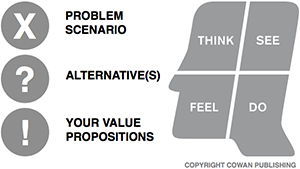
I like to start the customer discovery process with personas - vivid depictions of your customers in context (think-see-feel-do is a good checklist for describing them). These personas have problem scenarios - needs and desires they’d like to fulfill. They also have current alternatives - things they doing (or not doing) about the problem scenario today. You have a value proposition - something you’re going to offer that you hope is better enough than the current alternatives to win over the customer.
In our example, Helen the HR Manager’s top problem scenario is that it’s just about impossible for her to assess the technical abilities of candidates who come in for interviews. For Frank the Functional Manager, it’s possible, he has the expertise, but it’s time consuming and awkward. Right now, the alternatives for HR managers are to scan the resumes and maybe call references. For functional managers, it’s to go through an awkward, patchy assessment- or, equally likely, take it on a combination of faith and hope that the candidate has the necessary skills. The ‘Before’ board below describes this situation.
Before Enable Quiz
| Notes | Board |
|---|---|
|
Helen the HR Manager does an initial screening on Chris the Candidate. She can look at experience, but doesn’t really have the ability to validate the candidate’s skill set.
Chris the Candidate is then passed along to Frank the Functional Manager. |
 |
| Frank the Functional Manager is really busy and just goes and make the hire. |  |
|
But in this case a stitch in time would have saved nine - the candidate doesn't actually have the required skills to the degree Frank understood/expected/wanted.
Now Frank the Functional Manager has to figure out how to fix a situation where his employee doesn't have the right skill sets. |
 |
After Enable Quiz
The next board narrates the process once the personas of interest have access to the value propositions the Enable Quiz product offers.| Notes | Board |
|---|---|
| Helen the HR Manager now has a simple way to screen out candidates missing the skills Frank the Functional Manager has said are an absolute requirement. |  |
| Making good hires is rarely easy but Frank the Functional Manager now at least knows they’ll have a certain baseline skill set. |  |
| And life’s a lot better. |  |
Where? How?
All you need to storyboard is a surface and a writing implement. That said, getting started is daunting for some and I particularly like what they’ve done here at Storyboard That. Their tool’s approachable and easy to get going with since it’s web-based. The outputs are available in a few different formats. I usually grab the individual panels they output and put them in the type of table you see above.My advice is sit down and do a storyboard right now. A simple one will probably take you around 30 minutes. The first board above is actually embedded from the original on their site and you can use it as a starting point if you want.
Your Turn
What techniques have you used to better illustrate what you’ve supposed and what you’ve learned in your customer discovery? In particular, have you tried storyboards and how did they work for you? If you’re just trying them out, please let me know how it goes. Post a comment, respond to the related Tweet, drop me a line, post on LinkedIn- we’re in this together!About Alexander Cowan
Alex Cowan is the founder and CTO of Leonid Systems, a software company providing solutions to the world's largest communications providers. He has worked with companies ranging from start-ups to Fortune 100s, improving their competitive advantage in a fast-changing high-tech landscape. He lives in Aptos, California, and can be reached at www.alexandercowan.com, on Google Plus at Alexander Cowan.Kuidas kujutada probleemseid stsenaariume süžeeskeemide abil
Kuidas suurendada õpilaste kaasatust loo planeerimisega klassis?
Kasutage storyboard'e, et muuta tunnid interaktiivsemaks ja meeldejäävamaks. Visuaalne jutustamine aitab õpilastel organiseerida mõtteid ja ühendada ideid, muutes õppimise lõbusamaks ja tõhusamaks 2.–8. klassidele.
Valige lool teema
Valige teema või kontseptsioon, mida õpilased uurivad, näiteks teadusprotsess või ajalooline sündmus. Olulised teemad muudavad tegevused tähenduslikumaks ja suurendavad õpilaste osalust.
Jagage teema põhistseenide või sammudena
Tuvastage 4–6 peamist hetke või etappi tunnis. Selged sammud annavad õpilastele lihtsa raamistiku ja aitavad keskenduda olulisele.
Andke õpilastele storyboardi mallid
Jagage tühje koomiksiribasid või kasutage digitaalseid tööriistu, näiteks Storyboard That. Struktureeritud mallid juhendavad õpilasi ning teevad joonistamise ja kirjutamise vähem hirmutavaks.
Kutsuge õpilasi illustreerima ja jutustama iga stseeni
Julgustage õpilasi joonistama pilte ja lisama peamisele momendile selgitusi. Sõnade ja visuaalide ühendamine parandab arusaamist ning annab loomingulistele mõtlejatele võimaluse särada.
Share and discuss storyboards as a class
Have students present their storyboards, then discuss different perspectives and key ideas. Collaborative sharing builds confidence and deepens understanding through peer feedback.
Korduma kippuvad küsimused probleemstsenaariumide kujutamise kohta süžeeskeemide abil
What is storyboarding in customer discovery and how does it help educators?
Storyboarding in customer discovery is a visual technique that maps out a user's journey before and after using a product or service. For educators, it helps clarify student needs, pain points, and outcomes, making lesson planning and curriculum design more targeted and effective.
How can K-12 teachers use storyboards to improve their lesson plans?
K-12 teachers can leverage storyboards to visualize classroom scenarios, anticipate student challenges, and design lessons that directly address those needs. Storyboarding makes abstract concepts more concrete and helps teachers create engaging, student-centered activities.
What is the difference between storyboarding and traditional lesson planning?
Storyboarding focuses on mapping out the step-by-step experience of students, while traditional lesson planning often lists activities and objectives. Storyboards add a visual, narrative element that helps teachers spot gaps and opportunities in student understanding.
Why is visualizing 'before and after' scenarios useful for teachers?
Visualizing 'before and after' scenarios allows teachers to see the impact of their lessons on student skills and behaviors. It highlights areas for improvement and helps educators tailor instruction to maximize learning outcomes.
What are the steps to get started with storyboarding for a classroom activity?
To start storyboarding for a classroom activity: 1) Identify the learning objective, 2) Create personas for your students, 3) Map their experience before the lesson, 4) Outline the steps during the activity, and 5) Visualize the desired outcomes after the lesson.
© 2026 - Clever Prototypes, LLC - Kõik õigused kaitstud.
StoryboardThat on ettevõtte Clever Prototypes , LLC kaubamärk ja registreeritud USA patendi- ja kaubamärgiametis