

Unknown Story


טקסט Storyboard
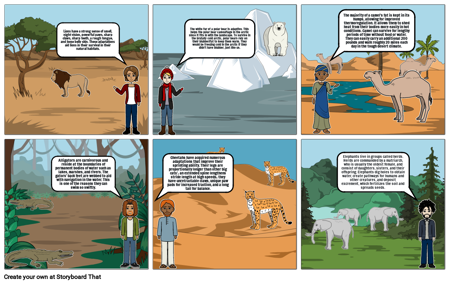
- Lions have a strong sense of smell, night vision, powerful paws, sharp claws, sharp teeth, a rough tongue, and loose belly skin. These adaptations aid lions in their survival in their natural habitats.
- The white fur of a polar bear is adaptive. This helps the polar bear camouflage in the arctic since it fits in with the landscape. To survive in the brutally cold arctic, polar bears rely on their blubber/fat to keep them warm. They would be freezing cold in the arctic if they didn't have blubber, just like us.
- The majority of a camel's fat is kept in its humps, allowing for improved thermoregulation. It allows them to shed heat from their bodies more easily in hot conditions. Camel can survive for lengthy periods of time without food or water. They can easily carry an additional 200 pounds and walk roughly 20 miles each day in the tough desert climate.
- Alligators are carnivorous and reside at the boundaries of permanent bodies of water such as lakes, marshes, and rivers. The gators' back feet are webbed to aid with navigation in the water. This is one of the reasons they can swim so swiftly.
- Cheetahs have acquired numerous adaptations that improve their sprinting ability. Their legs are proportionally longer than other big cats'; an extended spine lengthens stride length at high speeds; they have unretractable claws, unique paw pads for increased traction, and a long tail for balance.
- Elephants live in groups called herds. Herds are commanded by a matriarch, who is usually the oldest female, and consist of daughters, sisters, and their offspring. Elephants dig holes to obtain water, create pathways for humans and other creatures, and deposit excrement, which fertilizes the soil and spreads seeds.
מעל 40 מיליון לוחות סטוריבורד נוצרו
אין הורדות, אין כרטיס אשראי ואין צורך בכניסה כדי לנסות!
