

 Regisztrálj tanárként

The increasingly popular rubric of ‘customer development’ encompasses the traditional disciplines of marketing, product management, and entrepreneurship. It re-segments and combines these disciplines into something entirely focused on new product/business creation. Its practice (and its originator, Steve Blank) has one overriding directive: get out into the world and understand the customer. Paired with design thinking , the discipline is highly useful in today’s dynamic, hyper competitive environment.
My work is about helping put this and other related techniques into practice. Crucial to your ultimate success is anchoring your understanding of the customer in a picture of how you think they experience life before and after they have your product - before and after, basically. For this, I love storyboarding.
Storyboarding Before and After Scenarios
I use a (fictional) example company called Enable Quiz in my book, Starting a Tech Business: A Practical Guide for Anyone Creating or Designing Applications or Software. They offer lightweight technical quizzes for anyone looking to assess the skill sets of engineers they’re looking to hire. The personas are Helen the HR Manager, Chris the Candidate, and Frank the Functional Manager. Helen’s responsible for doing initial interviews, Chris is being interviewed for the job, and Frank’s the hiring manager (Chris’ hypothetical future boss).
The panels below show a before and after for Enable Quiz’s customers:

Breaking Down Our Story
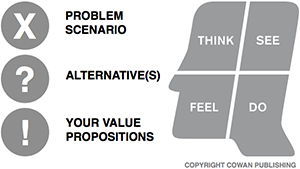
I like to start the customer discovery process with personas - vivid depictions of your customers in context (think-see-feel-do is a good checklist for describing them). These personas have problem scenarios - needs and desires they’d like to fulfill. They also have current alternatives - things they doing (or not doing) about the problem scenario today. You have a value proposition - something you’re going to offer that you hope is better enough than the current alternatives to win over the customer.
In our example, Helen the HR Manager’s top problem scenario is that it’s just about impossible for her to assess the technical abilities of candidates who come in for interviews. For Frank the Functional Manager, it’s possible, he has the expertise, but it’s time consuming and awkward. Right now, the alternatives for HR managers are to scan the resumes and maybe call references. For functional managers, it’s to go through an awkward, patchy assessment- or, equally likely, take it on a combination of faith and hope that the candidate has the necessary skills. The ‘Before’ board below describes this situation.
Before Enable Quiz
| Notes | Board |
|---|---|
|
Helen the HR Manager does an initial screening on Chris the Candidate. She can look at experience, but doesn’t really have the ability to validate the candidate’s skill set.
Chris the Candidate is then passed along to Frank the Functional Manager. |
 |
| Frank the Functional Manager is really busy and just goes and make the hire. |  |
|
But in this case a stitch in time would have saved nine - the candidate doesn't actually have the required skills to the degree Frank understood/expected/wanted.
Now Frank the Functional Manager has to figure out how to fix a situation where his employee doesn't have the right skill sets. |
 |
After Enable Quiz
The next board narrates the process once the personas of interest have access to the value propositions the Enable Quiz product offers.| Notes | Board |
|---|---|
| Helen the HR Manager now has a simple way to screen out candidates missing the skills Frank the Functional Manager has said are an absolute requirement. |  |
| Making good hires is rarely easy but Frank the Functional Manager now at least knows they’ll have a certain baseline skill set. |  |
| And life’s a lot better. |  |
Where? How?
All you need to storyboard is a surface and a writing implement. That said, getting started is daunting for some and I particularly like what they’ve done here at Storyboard That. Their tool’s approachable and easy to get going with since it’s web-based. The outputs are available in a few different formats. I usually grab the individual panels they output and put them in the type of table you see above.My advice is sit down and do a storyboard right now. A simple one will probably take you around 30 minutes. The first board above is actually embedded from the original on their site and you can use it as a starting point if you want.
Your Turn
What techniques have you used to better illustrate what you’ve supposed and what you’ve learned in your customer discovery? In particular, have you tried storyboards and how did they work for you? If you’re just trying them out, please let me know how it goes. Post a comment, respond to the related Tweet, drop me a line, post on LinkedIn- we’re in this together!About Alexander Cowan
Alex Cowan is the founder and CTO of Leonid Systems, a software company providing solutions to the world's largest communications providers. He has worked with companies ranging from start-ups to Fortune 100s, improving their competitive advantage in a fast-changing high-tech landscape. He lives in Aptos, California, and can be reached at www.alexandercowan.com, on Google Plus at Alexander Cowan.Hogyan ábrázoljuk a problémaforgatókönyveket storyboardokkal?
Növeld a diákok részvételét történetmeséléses storyboardokkal az osztályban
Használj storyboardokat az órák interaktívabbá és emlékezetesebbé tételéhez. Vizuális mesélés segít a diákoknak szervezni gondolataikat és összekapcsolni az ötleteket, így a tanulás élvezetesebb és hatékonyabb lesz 2–8. évfolyam számára.
Válassz egy tanóra témát storyboardozáshoz
Válassz egy tantárgyat vagy fogalmat, amit a diákjaid tanulnak, például egy tudományos folyamatot vagy egy történelmi eseményt. Releváns témák teszik a storyboardozási tevékenységeket értelmesebbé és növelik a diákok elköteleződését.
Törd szakaszokra a témát fő jelenetekre vagy lépésekre
Határozz meg 4–6 fő pillanatot vagy szakaszt az órán belül. Világos lépések egyszerű keretrendszert adnak a diákoknak, és segítenek nekik a lényegre összpontosítani.
Adj a diákoknak storyboard sablonokat
Oszd ki üres képregény rácsokat vagy használj digitális storyboard eszközöket, mint például a Storyboard That. Szerkezetes sablonok irányítják a diákokat és csökkentik a rajzolás és írás félelmét.
Bátorítsd a diákokat, hogy illusztráljanak és narráljanak minden jelenetet
Ösztönözd a diákokat, hogy rajzolják meg a képeket és írjanak feliratokat minden fő pillanathoz. Szavak és vizuális elemek kombinálása javítja a megértést és lehetővé teszi a kreatív gondolkodóknak, hogy kitűnjenek.
Share and discuss storyboards as a class
Have students present their storyboards, then discuss different perspectives and key ideas. Collaborative sharing builds confidence and deepens understanding through peer feedback.
Gyakran Ismételt Kérdések a Problémaforgatókönyvek Storyboards-szal való ábrázolásáról
Mi az a storyboarding a vásárlói felfedezés során, és hogyan segít az oktatóknak?
Storyboarding a vásárlói felfedezésben egy vizuális technika, amely megtervezi egy felhasználó útját a termék vagy szolgáltatás használata előtt és után. Az oktatóknak segít tisztázni a diákok szükségleteit, problémáit és eredményeit, ezáltal hatékonyabbá téve az óratervezést és a tanterv kialakítását.
Hogyan használhatják az általános iskolai és középiskolai tanárok a storyboardingot az óraterveik fejlesztéséhez?
A tanárok a közoktatásban kihasználhatják a storyboardingot, hogy vizualizálják az osztálytermi szcenáriókat, előre lássák a diákok kihívásait, és olyan órákat tervezzenek, amelyek közvetlenül reagálnak ezekre az igényekre. A storyboarding segít az absztrakt fogalmak konkretizálásában és az érdekes, tanulóközpontú tevékenységek létrehozásában.
Mi a különbség a storyboarding és a hagyományos óratervezés között?
A storyboarding a diákok lépésről lépésre történő élményének megtervezésére összpontosít, míg a hagyományos óratervezés inkább a tevékenységeket és célokat sorolja fel. A storyboarding vizuális, narratív elemeket ad hozzá, amelyek segítenek a tanároknak felismerni a hiányosságokat és lehetőségeket a diákok megértésében.
Miért hasznos a 'előtte és utána' szcenáriók vizualizálása az oktatók számára?
A 'előtte és utána' szcenáriók vizualizálása lehetővé teszi a tanárok számára, hogy lássák az óráik hatását a diákok képességeire és viselkedésére. Kiemeli a fejlesztendő területeket, és segít az oktatóknak személyre szabni az oktatást a tanulási eredmények maximalizálása érdekében.
Melyek a lépések a storyboarding elkezdéséhez egy osztálytermi tevékenységhez?
Az osztálytermi tevékenységhez történő storyboarding elkezdéséhez: 1) Határozza meg a tanulási célt, 2) Készítsen személyiségeket a diákjairól, 3) Térképezze fel az élményt az óra előtt, 4) Vázolja fel a lépéseket az aktivitás során, és 5) Vizualizálja a kívánt eredményeket az óra után.
© 2026 - Clever Prototypes, LLC - Minden jog fenntartva.
A StoryboardThat a Clever Prototypes , LLC védjegye, és bejegyzett az Egyesült Államok Szabadalmi és Védjegyhivatalában