

 Registreeru õpetajaks


Süžeeskeem Tekst
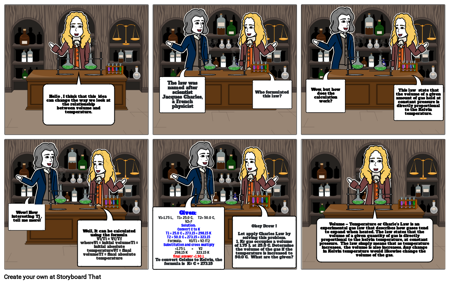
- Hello , I think that this  idea  can change the way we look at the relationship between volume and temperature.
- The law was named after scientist Jacques Charles, a French physicist
- Who formulated this law?
- Wow, but how does the calculation work?
- This law  state that the volume of a given amount of gas held at constant pressure is directly proportional to the Kelvin temperature.
- Wow! How interesting Tj , tell me more!
- Well, It can be calculated using the formula Vi/Ti = Vf/TfwhereVi = initial volumeTi = initial absolute temperatureVf = final volumeTf = final absolute temperature
- Given: V1=1.75 L,     T1= 25.0 C,      T2= 50.0 C,      V2=?Solution:Convert C to KT1 = 25.0 C + 273.15 = 298.15 KT2 = 50.0 C + 273.15 = 323.15Formula:         V1/T1 = V2 /T2Substitution and cross multiply=1.75 L        =       V2         298.15 K           323.15 Kfinal answer =1.90 LTo convert Celsius to Kelvin, the formula is  K= C + 273.15     
- Okey Drew ! Let apply Charles Law by solving this problem.1. Kr gas occupies a volume of 1.75 L at 25.0 C. Determine the volume of the gas if the temperature is increased to 50.0 C.  What are the given?
- Volume – Temperature or Charle’s Law is an experimental gas law that describes how gases tend to expand when heated. The law states that the volume of a given quantity of gas is directly proportional to the kelvin temperature, at constant pressure.  The law simply means that as temperature increases,  the volume is also increases. Any change in Kelvin temperature would likewise change the volume of the gas.
Loodud on üle 40 miljoni süžeeskeemi
Proovimiseks Pole Vaja Allalaadimist, Krediitkaarti ega Sisselogimist!
