

Untitled Storyboard


Süžeeskeem Tekst
- Libisema: 1
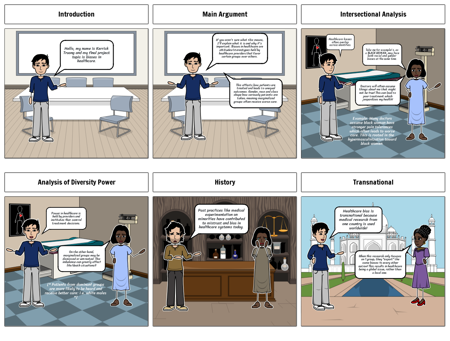
- Introduction
- Hello, my name is Kerrick Truong and my final project topic is biases in healthcare.
- Libisema: 2
- Main Argument
- If you aren't sure what this means, I'll explain what it is and why it's important. Biases in healthcare are attitudes/stereotypes held by healthcare providers that favor certain groups over others.
- This affects how patients are treated and leads to unequal outcomes. Gender, race and class shape how seriously patients are taken, meaning marginalized groups often receive worse care.
- Libisema: 3
- Intersectional Analysis
- Healthcare biases often overlap across identities.
- Take me for example! I, as a BLACK WOMAN, may face both racial and gender biases at the same time.
- Doctors will often assume things about me that might not be true! This can lead to poor treatment which jeopardizes my health!
- Example: Many doctors assume black woman have stronger pain tolerances which often leads to worse care. This is rooted in the hypermasculinization toward black women.
- Libisema: 4
- Analysis of Diversity Power
- Power in healthcare is held by providers and institutes that control treatment decisions.
- On the other hand, marginalized groups may be dismissed or untreated. This imbalance can greatly affect life/death situations!!
- [* Patients from dominant groups are more likely to be heard and receive better care: i.e. white males *]
- Libisema: 5
- History
- Past practices like medical experimentation on minorities have contributed to mistrust and bias in healthcare systems today.
- Libisema: 6
- Transnational
- Healthcare bias is transnational because medical research from one country is used worldwide!
- When this research only focuses on 1 group, they "export" the same biases to every other nation! This results in healthcare being a global issue, rather than a local one.