

 Registreeru õpetajaks
Unknown Story


Süžeeskeem Tekst
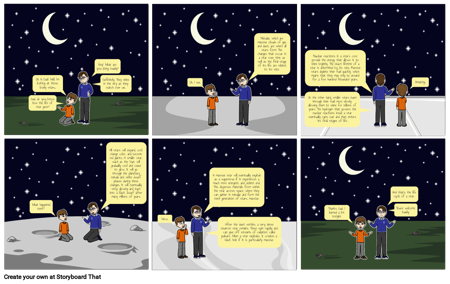
- Oh, hi Dad! Well, I'm looking at those lovely stars.
- Dad, do you know how the life of star goes?
- hey mister what are you watching
- i am admiring the combination of gas and dust pulled together by gravity
- Hey! What are you doing, buddy?
- Definitely. They shine in the sky as they watch over us.
- Oh, I see.
- hey mister what are you watching
- i am admiring the combination of gas and dust pulled together by gravity
- Nebulae, which are massive clouds of gas and dust, are where all stars form. The changes that occur in a star over time, as well as the final stage of its life, are related to its size.
- Nuclear reactions in a star's core provide the energy that allows it to shine brightly. The exact lifetime of a star is determined by its size. Massive stars deplete their fuel quickly, which means that they may only be around for a few hundred thousand years.
- On the other hand, smaller stars burn through their fuel more slowly, allowing them to shine for billions of years. The hydrogen that powers the nuclear reactions inside a star eventually runs out and then enters its final stages of life.
- hey mister what are you watching
- i am admiring the combination of gas and dust pulled together by gravity
- Amazing.
- What happened next?
- All stars will expand, cool, change color, and become red giants. A smaller star, such as the Sun, will gradually cool and cease to glow. It will go through the planetary nebula and white dwarf phases during these changes. It will eventually stop glowing and turn into a black dwarf after many millions of years.
- Wow.
- A massive star will eventually explode as a supernova if it experiences a much more energetic and violent end. This disperses materials from within the star across space, where they can gather in nebulae and form the next generation of stars. massive.
- After the dust settles, a very dense neutron star remains. These spin rapidly and can give off streams of radiation, called pulsars. When a star explodes, it creates a black hole if it is particularly massive.
- hey mister what are you watching
- i am admiring the combination of gas and dust pulled together by gravity
- Thanks Dad. I learned a lot tonight.
- hey mister what are you watching
- i am admiring the combination of gas and dust pulled together by gravity
- And that's the life cycle of a star.
- You're welcome, buddy.
Loodud on üle 40 miljoni süžeeskeemi
Proovimiseks Pole Vaja Allalaadimist, Krediitkaarti ega Sisselogimist!
