

Creative writing literary movements


Kuvakäsikirjoitus Teksti
- Liuku: 1
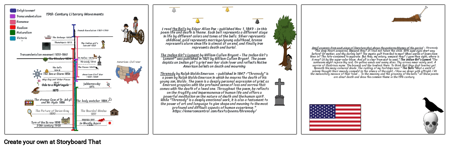
- Small excerpts from each piece of literature that shows the patterns/themes of the period - Threnody "The deep Heart answered, Weepest thou? If I had not taken the child. With aged eyes short way before? Of matter, and thy darling lost? The mystic gulf from God to man? When worlds of lovers hem thee in? The fate-conjoined to separate. But thou, my votary, weepest thou? I gave thee sight, where is it now? Lit by the super-solar blaze. And all is clear from east to west." The Indian Girl's Lament "The sunbeams might rejoice thy rest. On yellow woods and sunny skies. Thy arrows never vainly sent. A warrior of illustrious name. The bravest and the loveliest there. To think that thou dost love her yet. Beneath the many-coloured shade. The rustling of my footsteps near." The Bells "What a world of solemn thought their monody compels! In the silence of the night, / How we shiver with affright / At the melancholy menace of their tone! ... To the moaning and the groaning of the bells." all these poems are about death and show the common theme in the 19th century.
- The strange Case of Dr. Jekyll and Mr. Hyde 1886
- The body snatcher 1884
- Transcendentalism
- 19th Century Literary Movements
- Romance
- The Boarded Window 1891
- The Picture of Dorian Grey 1890
- Dracula 1897
- Realism
- Naturalism
- The Embargo 1808
- 20th century 1900
- Turn of the Screw 1898
- In Ghostly Japan 1899
- French Revolution 1787-1799
- Victorian
- Thanatopsis 1813
- The Indian girl's lament 1821
- Transcendentalism movement 1830-1860
- The Rhodora 1834
- To Hellen 1831
- Threnody 1842
- The bells 1848
- The Raven 1845
- American Civil War 1861-1865
- The Snow-Storm 1856
- May-Day and Other Pieces 1867
- Jabberwocky 1871
- Ode to a Nightingale 1875
- Liuku: 2
- I read the Bells by Edgar Allan Poe - published Nov. 1, 1849 - In this poem life and death is theme. Each bell represents a different stage in life by different colors and tones of the bells. Silver represents childhood, gold represents marriage/young adulthood, bronze represents alarm since life is almost at an end, and finally iron represents death and burial.The Indian Girl's Lament by William Cullen Bryant - The Indian Girl's Lament" was published in 1821 by William Cullen Bryant. The poem depicts an Indian girl's grief over her slain lover and reflects Native American beliefs on death and mourningThrenody by Ralph Waldo Emerson. - published in 1847 -"Threnody" is a poem by Ralph Waldo Emerson in which he mourns the death of his young son, Waldo. The poem is a deeply personal expression of grief, as Emerson grapples with the profound sense of loss and sorrow that comes with the death of a loved one. Throughout the poem, he reflects on the fragility and impermanence of human life and offers a powerful meditation on the nature of death and the human spirit. While "Threnody" is a deeply emotional work, it is also a testament to the power of art and language to give shape and meaning to the most profound and difficult aspects of human experience." https://emersoncentral.com/texts/poems/threnody/
- Liuku: 0
- Enlightenment
- Q