

casual


Kuvakäsikirjoitus Teksti
- TEST
- Hey guys we should start studying together since we have an exam coming up.
- TEST
- TEST
- Let's go to my house.
- TEST
- We totally should, it'll be awesome.
- TEST
- TEST
- Cool.
- TEST
- Ya, same.
- I'm down.
- TEST
- TEST
- Hello Jane, how can I help you?
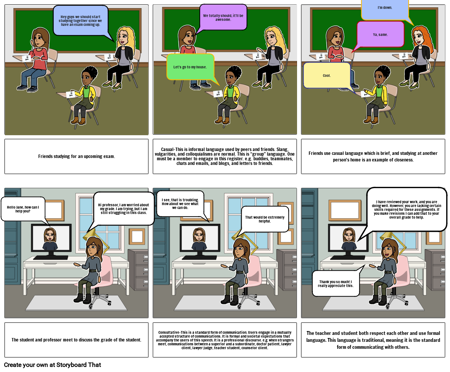
- Friends studying for an upcoming exam.
- Hi professor, I am worried about my grade. I am trying, but I am still struggling in this class.
- Casual-This is informal language used by peers and friends. Slang, vulgarities, and colloquialisms are normal. This is “group” language. One must be a member to engage in this register. e.g. buddies, teammates, chats and emails, and blogs, and letters to friends.
- I see, that is troubling. How about we see what we can do.
- That would be extremely helpful.
- Friends use casual language which is brief, and studying at another person's home is an example of closeness.
- Thank you so much! I really appreciate this.
- I have reviewed your work, and you are doing well. However, you are lacking certain skills required for these assignments. If you make revisions I can add that to your overall grade to help.
- The student and professor meet to discuss the grade of the student.
- Consultative-This is a standard form of communication. Users engage in a mutually accepted structure of communications. It is formal and societal expectations that accompany the users of this speech. It is a professional discourse. e.g. when strangers meet, communications between a superior and a subordinate, doctor patient, lawyer client, lawyer judge, teacher student, counselor client.
- The teacher and student both respect each other and use formal language. This language is traditional, meaning it is the standard form of communicating with others.